
News
Daniel Fuentes Espinal: The Maryland Pastor’s ICE Detention Case Explained


Quick Answer
Daniel Fuentes Espinal is a 54-year-old pastor from Honduras who has lived in Easton, Maryland, since 2001. On July 21, 2025, U.S. Immigration and Customs Enforcement (ICE) agents arrested him on his way to a construction job, citing a visa he overstayed 24 years earlier. His detention sparked community protests, drew support from Maryland lawmakers, and ended when an immigration judge granted him bond in August 2025, allowing him to return home to Easton.
Who Is Daniel Fuentes Espinal?
Fuentes Espinal leads Iglesia del Nazareno Jesús Te Ama, a Spanish-language Nazarene congregation of roughly 70 members in Easton, on Maryland’s Eastern Shore. He came to the United States from Honduras in 2001 on a six-month visa, according to ICE, and never returned to Honduras after it expired. Family members say he left Honduras after relatives were killed and the country’s instability left him with little choice but to go.
He first worked in construction after arriving in Maryland, drawing on experience he had as a youth minister in the Catholic Church back home. In 2010, he joined the local Nazarene church, eventually becoming its pastor while continuing to work in construction and carpentry to support his family. Community members describe him as a central figure in Easton’s immigrant community, someone who helped provide food, shelter, and emotional support to people in need.
Why Was He Detained by ICE?
Fuentes Espinal was stopped and detained on the morning of July 21, 2025, while driving to a construction site after stopping at a Lowe’s for materials and a McDonald’s for breakfast. According to his daughter, he was asked for identification and questioned about his immigration status before being taken into custody, with little explanation offered at the time.
ICE’s official explanation centers on his original visa. In a statement, the agency said he entered the country on a six-month visa in 2001 and stayed for 24 years past its expiration, and noted that overstaying a visitor’s visa is a federal crime. His case reflects a broader immigration enforcement priority under the current administration to expand deportation efforts, which has at times swept up long-term residents with no criminal history alongside people it targets as public safety risks.
Family members and supporters say Fuentes Espinal had spent years, and a significant amount of money, trying to obtain a green card through legal channels, describing the process as frustrating and difficult to navigate. He has no criminal record, according to his family and community members who spoke to reporters.
What Happened During His Detention?
After his arrest, Fuentes Espinal was moved through several facilities before ending up far from home:
- He was first held at a detention facility in Salisbury, Maryland.
- He was then transferred to a facility in Baltimore, where he reportedly spent about three nights sleeping on a concrete floor with only a thin aluminum blanket and no regular access to a shower.
- From Baltimore, he was flown roughly 1,000 miles away to the Winn Correctional Center in Winnfield, Louisiana, a facility used to hold immigration detainees.
Family friend Len Foxwell, an Eastern Shore political advisor close to the family, described the Baltimore facility’s conditions as inhumane, saying detainees lacked beds and basic sanitation. He also noted that phone calls from the detention center cost the family money at a point when they had lost their household’s main income earner.
While in Louisiana, Fuentes Espinal reportedly continued acting as a pastor to fellow detainees, preaching informally inside the facility.
Community and Political Response
News of the arrest triggered a quick and visible community reaction in Easton and beyond:
- Dozens of residents protested in Easton, calling Fuentes Espinal a pillar of the community.
- A GoFundMe campaign for his family raised tens of thousands of dollars within days.
- Activists held a rally near the ICE detention facility in Baltimore.
- U.S. Senator Chris Van Hollen and Representative Glenn Ivey, both Maryland Democrats, pressed the Department of Homeland Security for his release and later toured the facility where he was initially held.
- Maryland Governor Wes Moore’s office was also involved in advocacy on the family’s behalf, according to the family.
The case became a flashpoint in the broader national debate over immigration enforcement, illustrating how ICE actions targeting visa overstays can affect people with deep community roots and no criminal record, not just those the government considers dangerous.
How the Case Was Resolved
An immigration judge granted Fuentes Espinal bond in early August 2025. He was released from the Winn Correctional Center and reunited with his family in Maryland after roughly a month in detention. In a video message posted to social media shortly after his release, he thanked supporters for their prayers and expressed relief at being reunited with his family and congregation.
His release did not resolve his underlying immigration status. Bond allows a person to be free while their case proceeds through immigration court, but it does not grant legal permanent residency. Fuentes Espinal’s family has said they intend to keep pursuing a green card for him.
Common Misconceptions About the Case
Misconception: He was in the country illegally from the start. Fuentes Espinal entered the U.S. legally on a visitor visa in 2001. The legal issue is that he stayed after that visa expired, which is treated differently under immigration law than entering without authorization, though both can lead to removal proceedings.
Misconception: Bond means the case is over. Being released on bond only means he is not detained while his immigration case continues. The court process determining his long-term status is separate and ongoing.
Misconception: A clean criminal record protects someone from ICE detention. Having no criminal history does not automatically shield a person from immigration enforcement. Visa overstays and other civil immigration violations can result in detention regardless of criminal record.
Key Facts
- Full name: Daniel Omar Fuentes Espinal, age 54 at the time of his arrest.
- Country of origin: Honduras.
- U.S. residency: In the country since 2001, more than two decades before his arrest.
- Arrested: July 21, 2025, in Easton, Maryland.
- Occupation: Pastor of Iglesia del Nazareno Jesús Te Ama and a construction worker.
- Detention facilities: Salisbury, Maryland; Baltimore, Maryland; Winn Correctional Center in Winnfield, Louisiana.
- Released: Early August 2025, after an immigration judge granted bond.
- Criminal record: None reported by family, community members, or news outlets.
FAQ
What is Daniel Fuentes Espinal known for?
He is known as the pastor of a Spanish-language Nazarene congregation in Easton, Maryland, and as a longtime member of the local immigrant community who has provided support to people facing hardship.
Why did ICE detain him?
ICE detained him because he overstayed a six-month visitor visa he entered on in 2001, which the agency says constitutes a federal violation regardless of how long ago the visa expired.
Is overstaying a visa a crime?
Yes, overstaying the authorized period of a visitor visa is treated as a violation of federal immigration law, though enforcement and consequences vary by case.
Did he have legal representation?
His family worked with legal counsel during the immigration court proceedings that led to his bond hearing, though specific details about his legal team have not been widely reported.
What happened to him after his release?
He returned home to Easton and resumed his role at his church. His broader immigration case, including any path to permanent legal status, remains ongoing.
Where was he held during detention?
He was held first in Salisbury and Baltimore, Maryland, and later transferred to the Winn Correctional Center in Winnfield, Louisiana.
Key Takeaways
- Daniel Fuentes Espinal is an Easton, Maryland pastor detained by ICE in July 2025 over a 24-year-old visa overstay.
- He has no criminal record and had lived in the U.S. since 2001.
- His arrest drew strong community and political support, including from Maryland’s congressional delegation.
- He was held in facilities in Maryland and Louisiana before being granted bond and released in August 2025.
- His release resolved his detention but not his underlying immigration status, which remains an open legal matter.
Conclusion
Daniel Fuentes Espinal’s case became a widely covered example of how a decades-old visa overstay can lead to detention even for someone with no criminal history and deep ties to their community. His arrest, weeks in detention, and eventual release on bond highlight the gap between long-term, functional residency in the U.S. and formal legal status, a gap that continues to shape his family’s efforts to secure permanent residency for him.
Introduction
People searching for fintechzoom.io stocks are usually looking for stock-market information, company analysis, market trends, indexes, charts, or guidance on how to understand investment opportunities. FintechZoom.io has a dedicated stocks section that covers market topics ranging from individual companies to major indexes such as the Nasdaq and Dow Jones.
However, there is an important distinction that readers should understand before relying on information from the site. FintechZoom.io is a separate domain from FintechZoom.com, and FintechZoom.com has publicly stated that fintechzoom.io is not affiliated with its official website.
That does not mean every piece of information found on FintechZoom.io is automatically inaccurate. It means readers should identify the exact website they are using, evaluate the source of market data, check dates, and verify important investment information against primary sources before making financial decisions.
Direct Answer: What Are FintechZoom.io Stocks?
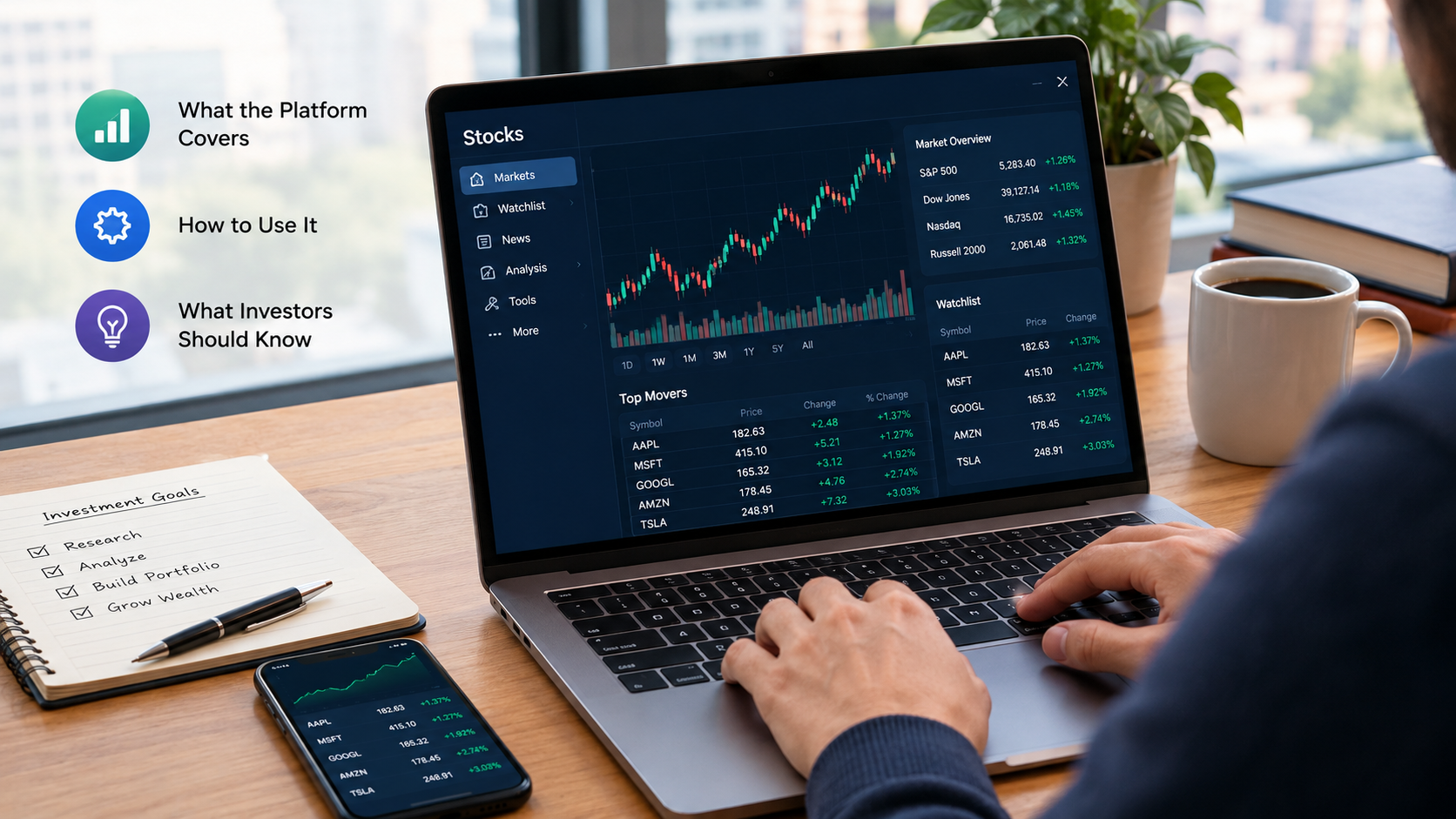
FintechZoom.io stocks refers to the stock-market coverage published through FintechZoom.io, including information and commentary about individual companies, major market indexes, stock trends, charts, and related financial topics. Its stocks section features subjects such as Nasdaq, Dow Jones, S&P 500, Apple, AMD, Disney, and other market-related topics. It is best treated as an information and research starting point rather than a substitute for regulated investment advice or primary financial sources.
What Is FintechZoom.io?
FintechZoom.io is a finance-focused website that publishes information across several areas of the financial markets. Its homepage describes coverage of stocks, Nasdaq, Dow Jones, cryptocurrency, gold, silver, real estate, and other financial subjects.
The site’s stock section is specifically designed to bring stock-market topics together in one place. Its current page includes links to articles covering individual companies, market indexes, commodities, and comparisons between different asset classes.
This makes the site potentially useful for someone who wants to explore a financial topic before conducting deeper research elsewhere.
For example, a reader might encounter an article about an individual technology company and then investigate:
- The company’s latest earnings
- Revenue growth
- Profit margins
- Debt
- Cash flow
- Valuation
- Competitors
- Industry conditions
- Broader market performance
The key point is that a stock article should normally be the starting point for research, not the entire investment process.
What Does the FintechZoom.io Stocks Section Cover?
The stocks section has a relatively broad scope. Rather than focusing on one industry or exchange, it covers different parts of the equity market.
The current stocks page includes content related to major market benchmarks and individual companies. Examples include Nasdaq, Dow Jones, FTSE 100, S&P 500-related coverage, Apple, AMD, Disney, and other securities and indexes.
Individual Stocks
Individual-stock coverage focuses on specific publicly traded companies.
A stock article may discuss:
- Recent price movements
- Company performance
- Earnings
- Business developments
- Industry trends
- Possible catalysts
- Risks
- Historical performance
- Investor sentiment
For instance, FintechZoom.io’s stocks page currently links to content about AMD and Apple, among other companies.
Readers should remember that an article about a company is not the same thing as a complete fundamental analysis.
Stock Market Indexes
Indexes provide a broader view of market performance.
FintechZoom.io covers major indexes including the Nasdaq and Dow Jones. Its homepage also discusses global market indexes and says its research extends beyond U.S. markets.
Understanding indexes can help investors put individual stock movements into context.
For example, if a technology stock falls 3% while the broader technology market falls 5%, the company’s performance may look different from simply seeing the stock’s negative percentage.
Technology Stocks
Technology companies receive significant attention because major technology stocks can influence broader market indexes.
Companies such as Apple and AMD appear among the stock-related subjects linked from FintechZoom.io’s stocks section.
When researching technology stocks, investors should consider more than price charts. Competition, product cycles, margins, research spending, regulation, and valuation can all influence long-term performance.
How FintechZoom.io Stocks Can Be Used for Research
A useful way to approach financial websites is to divide research into several stages.
Step 1: Identify the Stock
Start by confirming the exact company and ticker symbol.
This prevents a common mistake: researching a similarly named company or confusing a company with an index or exchange-traded fund.
Step 2: Read the Market Context
Look at the broader market.
Ask:
- Is the overall market rising or falling?
- Is the relevant sector outperforming?
- Are interest rates changing?
- Are investors becoming more or less risk-averse?
- Has an important economic announcement occurred?
A stock rarely moves in complete isolation.
Step 3: Check the Company’s Fundamentals
Fundamental analysis looks at the underlying business rather than only the stock chart.
Important measures include:
Revenue: How much money the company generates.
Earnings: The profit remaining after expenses.
Earnings per share (EPS): A measure of profit attributable to each share.
Free cash flow: Cash generated by the business after necessary capital expenditures.
Debt: Obligations that can affect financial flexibility.
Profit margin: The percentage of revenue that becomes profit.
Price-to-earnings ratio (P/E): A valuation measure comparing the stock price with earnings per share.
These numbers should be considered together rather than individually.
Step 4: Verify Important Information
If a stock article mentions earnings, acquisitions, regulatory developments, or company guidance, verify the information using a primary source whenever possible.
Useful primary sources can include:
- Company investor-relations pages
- SEC filings for U.S. public companies
- Official earnings releases
- Annual reports
- Quarterly reports
- Exchange information
- Official regulatory announcements
This additional step is particularly important when an article contains forecasts or strong claims about future performance.
Step 5: Consider Risk
Before reaching an investment decision, ask what could make the thesis wrong.
A company can have strong revenue growth and still be a poor investment if its valuation is extremely high.
Likewise, a stock that has fallen significantly is not automatically cheap.
Why FintechZoom.io Stock Information Can Be Useful
Financial websites can make complicated market subjects easier to understand.
One benefit of FintechZoom.io is its broad coverage. The platform does not limit itself to individual stocks. Its current material also covers cryptocurrencies, precious metals, real estate, and major financial indexes.
That broader perspective can help readers connect different market events.
For example, an investor researching a technology stock might also need to understand:
Interest rates → market valuations → technology-sector sentiment → individual-company valuation
The relationship is not always direct, but these factors can influence how investors price stocks.
Another benefit is accessibility. Someone unfamiliar with financial terminology may find an explanatory article easier to understand than a technical filing.
The limitation is that accessibility should not be confused with authority. Easy-to-read information still needs to be checked when the decision involves real money.
FintechZoom.io Stocks vs. Official Market Sources
This distinction is especially important.
FintechZoom.io is a financial information website. It is not the Nasdaq exchange itself, and it should not be confused with official market infrastructure.
Similarly, an article discussing an Apple stock price does not replace Apple’s official financial disclosures.
Think of the sources this way:
| Source | Primary Purpose |
| FintechZoom.io | Financial information, articles and market coverage |
| Company investor-relations website | Company announcements and financial disclosures |
| SEC | Regulatory filings and disclosures for U.S. public companies |
| Nasdaq | Exchange and market information |
| NYSE | Exchange and market information |
| Brokerage platform | Trading and account services |
This distinction helps prevent a common research mistake: assuming that because a website displays financial information, it is the original source of that information.
FintechZoom.io vs. FintechZoom.com: Why the Difference Matters
One of the biggest issues surrounding the keyword fintechzoom.io stocks is domain confusion.
The two websites have almost identical names:
- FintechZoom.io
- FintechZoom.com
They should not automatically be treated as the same organization.
FintechZoom.com identifies fintechzoom.com as its official domain and has published a warning that specifically lists fintechzoom.io among websites it says are not affiliated with FintechZoom.
FintechZoom.com has also advised users to be cautious about similarly named domains and to verify that they are visiting the genuine website.
Why This Matters to Investors
Brand confusion can create unnecessary risks.
A reader searching Google for “FintechZoom stocks” could encounter results from several similarly named domains. If the user does not check the address bar carefully, it is easy to assume that every result belongs to the same company.
For financial information, that assumption can be dangerous.
Before entering:
- Your name
- Email address
- Payment information
- Banking details
- Brokerage credentials
- Cryptocurrency wallet information
- Recovery phrases
always confirm exactly which website you are using.
Are FintechZoom.io Stock Predictions Guaranteed?
No. Stock-market predictions are never guaranteed.
A prediction is an estimate about a future outcome. It can be based on technical indicators, company fundamentals, historical trends, economic conditions, analyst expectations, or other information.
Even a well-reasoned forecast can be wrong.
For example, suppose an analyst expects a technology stock to rise because the company’s earnings are increasing. Unexpected events could still change the outcome:
- A weaker earnings report
- New regulation
- A competitor’s product launch
- Higher interest rates
- Economic recession
- Supply-chain problems
- Management changes
- Geopolitical events
The stock market prices future expectations, and those expectations can change quickly.
Therefore, readers should treat stock forecasts as scenarios rather than promises.
A Practical Example of Using FintechZoom.io Stocks
Imagine someone is researching a large technology company.
They find an article discussing the company’s recent stock performance.
Instead of immediately deciding to buy, a disciplined researcher could use the article as the first step:
First: Read the company’s recent market coverage.
Second: Check the latest earnings report.
Third: Compare revenue and earnings growth with previous periods.
Fourth: Examine the company’s valuation.
Fifth: Compare the company with competitors.
Sixth: Check how the relevant sector and broader market are performing.
Seventh: Identify the biggest risks.
Finally: Decide whether additional research is necessary.
This approach is much stronger than buying a stock simply because an article describes it as having strong potential.
Common Mistakes When Researching FintechZoom.io Stocks
Mistake 1: Confusing .io With .com
This is one of the most important issues.
Because the names are almost identical, users may assume that the two domains belong to the same organization. FintechZoom.com explicitly disputes that assumption.
Always check the complete domain.
Mistake 2: Treating a Forecast as a Fact
A prediction about where a stock might trade in the future is not a confirmed outcome.
Words such as “could,” “may,” “expected,” and “forecast” indicate uncertainty.
Mistake 3: Looking Only at Price
A stock price tells you what one share currently costs. It does not tell you whether the underlying company is financially healthy or attractively valued.
Mistake 4: Ignoring the Date
Financial information becomes outdated quickly.
An article written months ago may describe a completely different market environment.
Always check:
- Publication date
- Update date
- Earnings period
- Current price
- Current company guidance
Mistake 5: Using One Website as the Entire Research Process
No single financial website should normally be the only source behind a significant investment decision.
Compare information with primary documents and other reputable financial sources.
Mistake 6: Assuming Past Performance Predicts Future Returns
A stock that performed well historically can decline later.
Historical performance is useful context, but it is not a guarantee of future returns.
Key Concepts to Understand Before Reading Stock Analysis
Market Capitalization
Market capitalization represents the total market value of a company’s outstanding shares.
It is calculated approximately as:
Share price × shares outstanding = market capitalization
This helps investors compare companies by size.
Volatility
Volatility describes how sharply an asset’s price moves.
A highly volatile stock can experience large price changes over short periods.
Dividend Yield
Dividend yield compares annual dividends with the current share price.
It can help investors evaluate income-producing stocks, but a high yield is not automatically a sign of a better investment.
Diversification
Diversification means spreading investments across different assets, companies, sectors, or markets.
Its purpose is to reduce dependence on one investment.
Bull and Bear Markets
A bull market generally refers to a period of sustained optimism and rising prices.
A bear market generally describes a period of significant declines and weaker sentiment.
These terms describe broader market conditions rather than guaranteeing what an individual stock will do.
Is FintechZoom.io Useful for Beginners?
It can be useful as an educational starting point, especially for readers trying to understand market terminology, individual stocks, indexes, and broader financial topics.
The site presents information across several market categories, including stocks and major indexes.
However, beginners should be especially careful with forecasts and investment decisions.
A good beginner workflow is:
- Learn basic stock-market terminology.
- Understand how stocks and indexes work.
- Read market commentary.
- Verify important facts.
- Study company financial statements.
- Understand valuation.
- Learn about diversification and risk.
- Make decisions based on multiple sources rather than one article.
This approach builds financial literacy instead of encouraging decisions based on headlines.
Is FintechZoom.io a Brokerage?
Readers should distinguish between a financial information website and a brokerage platform.
A brokerage allows customers to open investment accounts and execute transactions in securities.
Financial publishing websites primarily provide information, research, commentary, or educational material.
Therefore, users should not assume that reading stock information on FintechZoom.io means they can safely or legally execute investments through the website.
Before sending money to any financial service, verify the legal entity, regulatory status, account structure, and exact services being offered.
How to Verify a Stock Claim You Read Online
A simple verification process can reduce mistakes.
1. Find the Original Source
If an article discusses company earnings, locate the company’s official earnings release or filing.
2. Check the Date
Make sure the information is current.
3. Compare Numbers
Check important figures against the company’s own filings or recognized market-data sources.
4. Separate Facts From Forecasts
“Revenue increased 12%” is a historical claim that can be checked.
“The stock will rise 30%” is a forecast and inherently uncertain.
5. Check the Context
A stock’s performance should be considered alongside its sector and the wider market.
6. Look for Contradictory Evidence
Good research does not only search for reasons to buy. It also looks for reasons the investment thesis could fail.
Key Facts About FintechZoom.io Stocks
- FintechZoom.io has a dedicated stocks section.
- Its stock coverage includes individual companies and market indexes.
- Nasdaq and Dow Jones are among the markets discussed by the platform.
- The website also covers areas such as crypto, gold, silver, and real estate.
- FintechZoom.io and FintechZoom.com are separate domains.
- FintechZoom.com identifies fintechzoom.com as its official domain.
- FintechZoom.com has publicly stated that fintechzoom.io is not affiliated with it.
- Stock forecasts should be treated as estimates, not guarantees.
- Important financial claims should be checked against primary sources.
- Investors should consider valuation, fundamentals, risk, diversification, and market conditions rather than focusing only on price movements.
Frequently Asked Questions
What is FintechZoom.io stocks?
FintechZoom.io stocks refers to the stock-market information and coverage available through the FintechZoom.io website. Its stocks section includes individual companies, market indexes, trends, and financial commentary.
Does FintechZoom.io cover Nasdaq?
Yes. Nasdaq is one of the major market subjects covered by FintechZoom.io. The site’s homepage describes coverage of Nasdaq and technology-focused market activity.
Does FintechZoom.io cover individual companies?
Yes. Its stocks section currently links to content concerning companies such as Apple, AMD, and Disney, alongside broader market topics.
Is FintechZoom.io the same as FintechZoom.com?
No. They are different domains. FintechZoom.com identifies itself as the official FintechZoom domain and has specifically stated that fintechzoom.io is not affiliated with it.
Can I rely on FintechZoom.io stock predictions?
Stock predictions should not be treated as guarantees. Market forecasts are uncertain and can change when company, economic, regulatory, or geopolitical conditions change.
Is FintechZoom.io a stock exchange?
No. FintechZoom.io is a financial information website. It should not be confused with an exchange such as Nasdaq or the New York Stock Exchange.
Should I buy a stock because FintechZoom.io discusses it?
Not solely because it appears in an article. A responsible investment decision requires additional research into the company, valuation, financial statements, risks, market conditions, and your own circumstances.
How can I verify stock information from FintechZoom.io?
Check the company’s investor-relations website, SEC filings where applicable, official earnings releases, and recognized market-data sources. Also check the publication date because financial information can become outdated.
Why does the FintechZoom.io and FintechZoom.com distinction matter?
The domains have similar names, which can cause confusion. FintechZoom.com has publicly warned that fintechzoom.io is not affiliated with its official website.
Is stock investing risk-free?
No. Stocks can lose value, sometimes rapidly. Investors can lose part or all of the money invested in an individual security, depending on the circumstances.
Key Takeaways
- FintechZoom.io stocks refers to the stock-market coverage published on FintechZoom.io.
- The platform covers individual companies, major indexes, market trends, and related financial topics.
- Nasdaq and Dow Jones are among its major market subjects.
- FintechZoom.io should be viewed as a research and information source rather than a replacement for primary financial documents.
- Stock forecasts are estimates, not guaranteed outcomes.
- Always check the date and source behind financial claims.
- Do not confuse FintechZoom.io with FintechZoom.com.
- FintechZoom.com has publicly identified fintechzoom.com as its official domain and stated that fintechzoom.io is not affiliated with it.
- Verify important information before committing money.
- A strong investment process considers fundamentals, valuation, risk, diversification, and broader market conditions.
Conclusion
FintechZoom.io stocks covers a broad range of stock-market subjects, from individual companies to major indexes such as Nasdaq and Dow Jones. The platform can help readers discover financial topics, understand market terminology, and explore company or market-related discussions.
The most important point is to understand what the information represents. A financial article, chart, or forecast is not the same as an official company filing, stock exchange record, or personalized investment recommendation.

Introduction
If you have recently come across neworldsmagazine.com, you may be wondering what kind of website it is, what topics it covers, whether its articles are reliable, and whether it is a traditional magazine or a broader online publishing platform.
The answer is fairly straightforward: neworldsmagazine.com is a general-interest online magazine that publishes articles across areas such as business, entertainment, fashion, lifestyle, news, technology, health, home improvement, education, travel, and fitness. Its homepage currently describes NeworldsMagazine as a source for global news, culture, innovation, and lifestyle trends.
However, understanding a website is about more than looking at its title. A useful assessment should consider its actual categories, publishing patterns, author information, transparency, access model, and the difference between general-interest content and specialist information.
This article examines those factors so readers can understand what neworldsmagazine.com is, what it can be useful for, and where additional verification may be sensible.
Direct Answer: What Is Neworldsmagazine.com?
Neworldsmagazine.com is a broad online magazine and digital publishing website covering topics such as business, entertainment, fashion, lifestyle, news, technology, health, home improvement, education, travel, and fitness. Its homepage presents the publication as a source for global news, culture, innovation, and lifestyle trends. Articles are organized into categories and are generally available to read publicly without an apparent mandatory subscription.
What Does Neworldsmagazine.com Publish?
The easiest way to understand the website is to examine its live content rather than rely only on its name or descriptions published elsewhere.
The current homepage contains several main navigation categories:
- Business
- Entertainment
- Fashion
- Lifestyle
- News
- Technology
The homepage also currently features content under areas such as Health, Home Improvement, Education, Travel, and Fitness.
This makes Neworldsmagazine.com a multi-topic publication, rather than a specialist website dedicated to one industry.
For example, a visitor might encounter an article about personal loans in the Business section, a travel article about Albania, a health article about dentistry, a fashion article about cashmere, and a technology article about artificial intelligence during the same visit.
That variety is one of the defining characteristics of the site.
Main Categories on Neworldsmagazine.com
Business
The Business section covers subjects related to money, companies, professional life, and broader business decisions.
Current examples include articles discussing personal borrowing terms, digital migration, interest rates, and business ownership.
For a general reader, this type of content can be useful as an introduction to a topic. However, financial decisions often require information from banks, regulators, financial professionals, or primary sources in addition to a general-interest article.
Technology
Technology is another significant category.
The site currently features topics involving artificial intelligence, cybersecurity, software updates, digital migration, AI models, and digital search visibility.
Technology articles can change quickly, so readers should pay attention to publication dates when researching software, AI products, security practices, or other rapidly changing subjects.
Entertainment
The Entertainment section includes articles concerning games, live music, events, television-related subjects, and other forms of entertainment. Recent homepage examples include content about Diablo 4, live music, acting careers, and entertainment access.
This section is generally less dependent on technical evidence than subjects such as medicine or finance, although factual claims about people, releases, dates, and events can still benefit from verification.
Fashion
Fashion content covers clothing, jewelry, styling, and related consumer interests.
Examples visible on the website include articles about cashmere sweaters and lab-grown diamond jewelry.
Readers using fashion content for inspiration can usually treat it differently from content involving health or financial decisions. Fashion advice often involves personal preference rather than a single objectively correct answer.
Lifestyle
Lifestyle is a broad category that can include everyday interests, habits, travel, personal choices, and cultural subjects.
Because the category is broad, readers should evaluate individual articles on their own merits rather than assuming that every article represents the same level of expertise.
News
The News section contains general-interest stories and articles about current topics.
News content requires particular attention to dates because information can become outdated quickly. A reader researching a current event should check when an article was published and compare important claims with primary or established news sources.
Health
Health is one of the areas where source quality matters most.
Neworldsmagazine.com currently publishes health-related material, including articles concerning dentistry and skincare product development.
General health articles can help readers understand terminology or identify questions to discuss with a qualified professional. They should not automatically be treated as a substitute for medical advice, clinical guidelines, or professional diagnosis.
Home Improvement
The site also publishes home-related content, including property inspection and home improvement subjects.
Such articles can be useful for generating questions and understanding common issues, but construction, property, electrical, plumbing, and legal matters can depend heavily on local rules and professional assessment.
Who Writes for Neworldsmagazine.com?
One notable feature of the current homepage is the repeated “By Carlos” attribution on many articles.
The homepage shows Carlos as the author of numerous recent pieces across different categories, including Business, Entertainment, Fashion, Health, and Technology.
That tells readers who is displayed as the author, but it does not automatically establish the person’s professional qualifications in every subject covered by the site.
For example, an author publishing articles about technology, health, fashion, and finance may not necessarily be a specialist in all four areas.
This is a useful general rule when evaluating online information:
An author byline establishes attribution, not necessarily subject-matter expertise.
Readers should look for additional information such as professional credentials, citations, first-hand research, institutional affiliation, or references to authoritative sources when those factors matter.
Is Neworldsmagazine.com a Newspaper?
Not in the traditional sense.
Neworldsmagazine.com is better described as a digital magazine or general-interest online publication.
A traditional newspaper typically has a clearly defined newsroom structure, reporting operation, editorial staff, and established news-gathering process. An online magazine can have a much broader publishing model and may mix explainers, lifestyle pieces, opinion-style content, guides, and general-interest articles.
Neworldsmagazine.com’s current category structure reflects that broader magazine model.
Is Neworldsmagazine.com a Specialist Website?
No.
The site’s broad subject coverage means it should not be treated as a specialist authority in a single field.
A specialist publication might focus almost entirely on:
- Medicine
- Law
- Finance
- Cybersecurity
- Scientific research
- Technology
- Fashion
- Travel
Neworldsmagazine.com covers many of these areas at a general-interest level instead.
That can be an advantage for discovery, but it also means readers should use different standards for different topics.
An entertainment article and a medical article do not require exactly the same level of evidence.
Is Neworldsmagazine.com Free to Read?
The public pages reviewed for this article were accessible without a mandatory reader subscription or visible paywall.
The homepage provides direct links to individual articles and category pages, while the site’s information pages are also publicly accessible.
That means an ordinary visitor can browse the publication without first creating a paid account.
Website access models can change, however, so this should be understood as a description of the site as observed rather than a permanent guarantee.
Does Neworldsmagazine.com Require an Account?
There was no indication on the public pages reviewed that readers must create an account simply to read the ordinary articles.
The website is structured around open web pages, category archives, and individual posts.
This makes it relatively straightforward for a visitor to arrive through a search engine, open an article, and continue browsing related content.
What Does the Website Say About Its Purpose?
The homepage describes NeworldsMagazine as a source for global news, culture, innovation, and lifestyle trends and says that it aims to provide stories, features, and updates connected with the changing world.
That description aligns reasonably well with the broad category structure visible on the site.
The publication is not limited to breaking news. Its current content includes practical guides, explanatory pieces, cultural topics, consumer subjects, technology articles, and lifestyle material.
In other words, its identity is broader than the word “news” might suggest.
How Does Neworldsmagazine.com Work?
From a reader’s perspective, the site works like a conventional online magazine.
A typical journey looks like this:
Step 1: Find an article
A reader may discover a page through a search engine, social platform, direct link, or the site’s homepage.
Step 2: Check the category
The category gives the reader an initial idea of the subject, such as Business, Technology, Fashion, or Entertainment.
Step 3: Check the author and date
The article’s byline and publication date provide useful context.
Step 4: Read the article
The visitor can generally access the article directly without a mandatory subscription.
Step 5: Verify important claims when necessary
If the topic involves medical treatment, financial decisions, legal rights, security, or other high-stakes issues, readers should consult stronger primary or specialist sources.
This last step is not unique to Neworldsmagazine.com. It is a good research habit for almost any general-interest publication.
How to Judge the Quality of a Neworldsmagazine.com Article
A website’s overall quality should not be reduced to a single yes-or-no label.
A better approach is to evaluate the individual article.
Ask five questions.
1. Who wrote it?
Look at the author’s name and determine whether the article requires specialist expertise.
2. When was it published?
A technology or news article may become outdated quickly.
3. What evidence does it provide?
Look for links, studies, official documents, interviews, data, or other supporting evidence.
4. Is the claim high-stakes?
Health, finance, legal, safety, and cybersecurity claims deserve more careful verification.
5. Can the information be confirmed elsewhere?
For important claims, compare the article with an official or specialist source.
This method is more useful than asking whether an entire website is simply “good” or “bad.”
Is Neworldsmagazine.com Legit?
The answer depends on what legit means.
If the question is whether neworldsmagazine.com is an active website with a functioning publication, the answer is yes. The domain resolves to an active site, the homepage contains current categories and dated articles, and the website provides public contact and privacy pages.
If “legit” means whether every article should automatically be considered authoritative, the answer is no. A general-interest website should not automatically be treated as a specialist authority on every subject it covers.
That distinction is important.
A website can be a legitimate publication while individual articles still vary in depth, sourcing, or expertise.
Who Owns Neworldsmagazine.com?
Ownership is one area where readers should be careful.
The public Contact page provides an email address, admin@rabbiitfirm.com, for general inquiries and feedback. It also says that the publication operates primarily online.
However, a contact email does not by itself establish the legal owner of a website.
Likewise, seeing the same author name across articles does not prove that the author owns the publication.
Therefore, unless stronger corporate or legal documentation is available, it is better to describe the ownership structure as not clearly established from the public information reviewed rather than assign ownership to a particular individual or company.
When Was Neworldsmagazine.com Registered?
Public domain information reported by IPAddress.com lists a registration date of June 26, 2024, with GoDaddy.com, LLC identified as the registrar.
However, readers should understand an important distinction:
Domain registration date is not necessarily the same as publication launch date.
A person or company can register a domain and launch a website later. Conversely, a website can change ownership or publishing direction during the life of a domain.
Therefore, June 26, 2024 should be treated as the reported domain registration date, not automatically as the founding date of the magazine.
Where Is Neworldsmagazine.com Hosted?
IPAddress.com reports an observed server location in Montreal, Canada, associated with the site’s resolved IP address.
This should not be confused with the physical location of the publisher.
Websites can use hosting companies, cloud infrastructure, content delivery systems, and servers located in countries far from the people who operate them.
Therefore:
Server location does not prove company location, publisher nationality, or editorial headquarters.
Does Neworldsmagazine.com Have HTTPS?
Yes.
The domain information reviewed indicates HTTPS support and an SSL/TLS certificate.
HTTPS encrypts the connection between a visitor’s browser and the website. It is an important basic security feature.
However, HTTPS does not prove that every piece of content on a website is accurate.
Security and editorial reliability are separate questions.
A site can have HTTPS and still publish poorly sourced information. Likewise, a website can be technically secure without being an authoritative source for a specialist subject.
Is Neworldsmagazine.com Safe to Visit?
There is no evidence from the sources reviewed that simply visiting the domain is inherently unsafe.
The website uses HTTPS, has public information pages, and operates as a conventional content publication.
Still, ordinary web-safety practices remain sensible:
- Do not download unknown files.
- Do not enter passwords unnecessarily.
- Be cautious with unexpected redirects.
- Verify claims before acting on them.
- Do not provide payment information unless you understand why it is being requested.
- Treat health, financial, and legal information as information to investigate rather than automatic professional advice.
These precautions apply broadly across the internet.
Is Neworldsmagazine.com Reliable?
A more accurate answer is article-dependent.
For general-interest subjects, the website can be useful as a source for ideas, explanations, and introductory information.
For high-stakes subjects, readers should verify important claims against primary or specialist sources.
For example:
| Topic | Recommended verification |
| Entertainment | Official studio, artist, publisher, or event source |
| Technology | Official documentation and manufacturer/developer sources |
| Health | Medical organizations, clinicians, peer-reviewed research |
| Finance | Banks, regulators, financial institutions, official statistics |
| Legal topics | Government agencies, legislation, qualified legal professionals |
| Travel | Official tourism authorities and transportation providers |
| News | Multiple established news sources and primary statements |
This approach does not mean every article is inaccurate. It means the level of verification should match the consequences of getting the information wrong.
What Are the Strengths of Neworldsmagazine.com?
Broad topic coverage
The site’s wide range of categories allows readers to explore different subjects from one publication.
Easy access
Public articles can be accessed directly without an obvious mandatory subscription requirement.
Simple category structure
The navigation separates major areas such as Business, Entertainment, Fashion, Lifestyle, News, and Technology.
Variety of article formats
The site publishes explanatory articles, practical guides, trend-related content, and general-interest pieces.
Useful starting point
For readers who are beginning research on an unfamiliar subject, a general-interest article can provide terminology and questions for further investigation.
What Are the Limitations?
Broad coverage can mean uneven expertise
A publication covering many subjects cannot automatically be assumed to have specialist expertise in all of them.
Author credentials may require further investigation
A byline tells readers who is credited with the article, but it does not necessarily demonstrate professional qualifications.
Current information can become outdated
This is particularly relevant for news, technology, finance, and other fast-moving topics.
Public ownership information is limited
The public Contact page provides an email address and describes the publication as primarily online, but that alone does not establish a complete ownership structure.
High-stakes claims need stronger verification
Readers should not rely on a general-interest article alone for major medical, legal, financial, or safety decisions.
Common Misunderstandings About Neworldsmagazine.com
“It is only a news website.”
Not exactly. Its current navigation and homepage show a much broader magazine model covering business, entertainment, fashion, lifestyle, technology, news, and other areas.
“The domain registration date is the magazine’s founding date.”
Not necessarily. Domain registration and publication launch are different events.
“HTTPS means the information is trustworthy.”
No. HTTPS protects the connection; it does not fact-check articles.
“Every article is written by a specialist.”
The presence of a byline does not automatically establish specialist credentials.
“A server in Canada means the publication is Canadian.”
No. Server location reflects hosting infrastructure, not necessarily the publisher’s physical location.
“A general-interest website is useless for serious research.”
That is also too broad. General-interest publications can be useful for orientation and discovery. The key is knowing when to move from an introductory source to a primary or specialist source.
Real-World Example: Researching a Health Topic
Imagine someone finds an article on Neworldsmagazine.com about dental health.
A sensible research process would be:
- Read the article to understand the basic issue.
- Identify any medical claims.
- Look for supporting references.
- Compare those claims with information from a dental association, government health agency, peer-reviewed research, or qualified clinician.
- Avoid changing treatment based solely on a general-interest article.
This approach allows the reader to benefit from accessible information without confusing magazine content with personalized medical advice.
Real-World Example: Researching a Technology Topic
Suppose a reader finds an article about an AI tool.
The article may explain what the tool does and why people use it.
Before making a purchase, changing a workflow, or relying on a technical claim, the reader should also check:
- Official documentation
- Current pricing
- Product specifications
- Security information
- Developer announcements
- Recent release notes
Technology changes quickly, so even a well-written article can become outdated.
Is Neworldsmagazine.com Useful for Discovering Topics?
Yes.
One of the strongest uses of a broad online magazine is topic discovery.
A reader may start with a simple question and discover related subjects through categories.
For example:
Business → technology → AI → cybersecurity
or:
Fashion → jewelry → lab-grown diamonds → consumer considerations
The value is not necessarily that one article answers every possible question. Instead, it can help the reader understand the subject and identify what to research next.
How Should Readers Use Neworldsmagazine.com?
A practical approach is:
1. Use it for orientation
Start with the article to understand the basic subject.
2. Identify important claims
Separate facts, opinions, recommendations, and predictions.
3. Check the date
This is especially important for news and technology.
4. Examine the author
Look for qualifications when the subject requires specialist knowledge.
5. Verify important information
Use official or specialist sources for consequential decisions.
6. Treat the article as one source
Good research rarely depends on a single webpage.
Key Facts About Neworldsmagazine.com
- Neworldsmagazine.com is an online general-interest publication.
- Its homepage currently features Business, Entertainment, Fashion, Lifestyle, News, and Technology categories.
- The site also publishes material related to Health, Home Improvement, Education, Travel, and Fitness.
- Its homepage describes NeworldsMagazine as a source for global news, culture, innovation, and lifestyle trends.
- Many current homepage articles are attributed to Carlos.
- The public Contact page lists admin@rabbiitfirm.com for general inquiries and feedback.
- The site has publicly accessible privacy and contact pages.
- Public domain information reports registration on June 26, 2024.
- HTTPS support has been detected for the domain.
- Server location information points to Montreal, Canada, but server location should not be interpreted as publisher location.
- The site is better understood as a general-interest digital magazine than as a specialist journal or traditional newspaper.
Frequently Asked Questions
What is neworldsmagazine.com?
Neworldsmagazine.com is a general-interest online magazine covering topics including business, entertainment, fashion, lifestyle, news, technology, health, home improvement, education, travel, and fitness.
Is Neworldsmagazine.com a legitimate website?
It is an active online publication with a functioning homepage, category structure, public contact page, privacy page, and published articles. Whether an individual article is reliable should be judged separately based on its author, evidence, date, and subject.
Is Neworldsmagazine.com free?
The public articles reviewed were accessible without an apparent mandatory subscription or paywall. Access conditions can change over time.
Who owns Neworldsmagazine.com?
The public information reviewed does not establish a complete legal ownership structure. The Contact page provides an email address for inquiries, but a contact address alone does not prove legal ownership.
Who writes the articles?
Many articles currently displayed on the homepage are attributed to Carlos.
Is Neworldsmagazine.com a news site?
It includes a News category, but it is broader than a conventional news organization. The website also publishes business, entertainment, fashion, lifestyle, technology, health, and other material.
Is Neworldsmagazine.com safe?
There is no indication from the reviewed sources that simply visiting the site is inherently unsafe. The domain supports HTTPS. However, visitors should still follow normal web-safety practices and avoid treating online content as automatically trustworthy.
Does Neworldsmagazine.com use HTTPS?
Yes. Available domain information reports HTTPS support and an SSL/TLS certificate for the hostname.
When was the domain registered?
Public domain information reports a registration date of June 26, 2024. This should not automatically be interpreted as the magazine’s official founding date.
Where is Neworldsmagazine.com located?
The site’s observed server infrastructure has been reported in Montreal, Canada. That does not establish the physical location of the publisher or editorial team.
Can I trust Neworldsmagazine.com for health information?
It can be used for general reading and topic discovery, but important health claims should be checked against medical organizations, scientific literature, government health agencies, or qualified healthcare professionals.
Can I trust it for financial advice?
Readers should not rely on a general-interest article alone for major financial decisions. Important financial information should be checked with banks, regulators, financial institutions, official statistics, or qualified financial professionals.
Does Neworldsmagazine.com cover technology?
Yes. Technology is one of the site’s main navigation categories, and its homepage currently features articles involving AI, cybersecurity, software, digital migration, and related subjects.
Is Neworldsmagazine.com a specialist publication?
No. Its broad category structure makes it a general-interest publication rather than a specialist journal focused on one field.
What is the best way to use Neworldsmagazine.com?
Use it as a source for general information, topic discovery, and accessible explanations. For high-stakes decisions, verify important claims through authoritative primary or specialist sources.
Key Takeaways
- Neworldsmagazine.com is a broad online magazine, not a single-topic website.
- It covers Business, Entertainment, Fashion, Lifestyle, News, Technology, and several additional subject areas.
- The website describes itself as a source for global news, culture, innovation, and lifestyle trends.
- Many current articles are attributed to Carlos, but an author byline does not automatically prove specialist expertise.
- The public Contact page lists an email address but does not, by itself, establish legal ownership.
- Public domain information reports that the domain was registered on June 26, 2024.
- The domain uses HTTPS, but technical security should not be confused with editorial accuracy.
- The reported server location is Montreal, Canada, but that does not establish where the publisher is based.
- The site’s usefulness depends heavily on the individual article and subject.
- Health, finance, legal, cybersecurity, and other high-stakes claims deserve independent verification.
- For general-interest reading and topic discovery, the site’s broad category structure can be useful.
Conclusion
Neworldsmagazine.com is best understood as a general-interest digital magazine that brings together articles covering business, entertainment, fashion, lifestyle, news, technology, health, home improvement, travel, education, and related subjects. Its current homepage and navigation clearly show a broad publishing model rather than a narrow specialist focus.
That broad scope is both its main attraction and something readers should keep in mind. A single publication can offer useful introductions to many subjects, but expertise and evidence requirements vary considerably between topics.
For entertainment or lifestyle reading, an accessible magazine article may be enough to satisfy a reader’s needs. For medical, financial, legal, security, or other consequential questions, the better approach is to use the article as a starting point and then verify important claims through authoritative sources.
The public information also supports a few technical facts: the domain was reported as registered on June 26, 2024, HTTPS is enabled, and the site’s public pages include contact and privacy information.

Al Sharpton’s name comes up in arrest-related searches more than almost any other American civil rights figure, and there’s a simple reason for that. Planned civil disobedience, meaning protests where arrest is an expected outcome, has been part of his activism strategy for decades. That history means there isn’t one single answer to “was Al Sharpton arrested,” since it’s happened more than once, in different contexts, for different reasons.
This article lays out the actual timeline: which arrests are documented, what they were connected to, and whether anything recent backs up the searches asking if it’s happening again right now.
Direct Answer
Al Sharpton has been arrested multiple times throughout his decades of activism, most notably during a 2001 protest against U.S. Navy bombing exercises on Vieques, Puerto Rico, which led to a 90-day jail sentence, and again in 2008 during protests over the Sean Bell shooting, which resulted in a disorderly conduct conviction with no additional jail time. As of the most recent available information, he has not been arrested in 2025 or 2026.
Why Al Sharpton Has Been Arrested Before
Sharpton founded the National Action Network, a civil rights organization built around organized protest and advocacy. Civil disobedience, deliberately breaking a minor law like trespassing to draw attention to a cause, has been one of his consistent tactics since the 1980s. Because of that, arrest has been a recurring, sometimes intentional, part of his activism rather than something that happened to him unexpectedly.
This is a meaningful distinction. Arrests tied to organized protest activity are generally treated very differently, legally and socially, than arrests connected to unrelated criminal conduct.
Timeline of Documented Arrests
Theatre District Protest (2000)
In April 2000, Sharpton led a large civil disobedience demonstration in New York’s Theatre District, and roughly 20 members of his group were arrested during the protest. This was one of several organized demonstrations Sharpton led in New York City around that period.
Vieques Protest and Prison Sentence (2001)
This remains the most significant arrest in Sharpton’s history. He was arrested on May 1, 2001, along with a dozen other protesters, for trespassing on U.S. Navy land during demonstrations against bombing exercises on the Puerto Rican island of Vieques. More than 180 people were arrested in the broader wave of protests that spring.
A federal judge sentenced Sharpton to 90 days in jail on May 23, 2001, along with a $500 fine. Because he had a prior civil disobedience arrest on his record, he received a longer sentence than several co-defendants. He served about 86 days before his release in August 2001.
Sean Bell Protests (2008)
In May 2008, Sharpton organized a coordinated, citywide “Day of Civil Disobedience” following the acquittal of police officers involved in the fatal shooting of Sean Bell. Nearly 200 demonstrators, including Sharpton, were arrested during the protests, which included blocking streets near the Brooklyn Bridge. He was later convicted of two counts of disorderly conduct and sentenced to time already served, meaning he didn’t spend additional time in custody beyond his initial arrest.
Has Al Sharpton Been Arrested Recently?
No. As of the most recent available reporting, Sharpton has not been arrested in 2025 or 2026. Recent news coverage of him has focused on public appearances, speeches, and organizing efforts, including leading a march in New York in August 2025, rather than any new legal trouble.
Where the Confusion Comes From
A few different things tend to fuel recent search interest in this topic:
Old stories resurfacing without dates. Sharpton’s activism history spans more than 40 years, and older news about his arrests sometimes circulates online without clear context, making it look like recent news.
Unrelated news involving other people. In early 2026, a television segment listing notable individuals held at a federal detention center in Brooklyn, unrelated to Sharpton, was shared on social media without context. Some viewers mistakenly connected his name to that story, despite him having no connection to it.
Misidentification. Because Sharpton is a prominent, frequently discussed public figure, his name occasionally gets attached to unrelated stories about arrests or legal issues involving other people entirely.
Common Mistakes When Researching This Topic
Mistake: Assuming any arrest news about Sharpton is current. Most search results connected to “Al Sharpton arrested” point back to events from 2000, 2001, or 2008. Always check the publication date before assuming a story is recent.
Mistake: Treating protest-related arrests the same as criminal arrests. Sharpton’s arrests have consistently been tied to organized civil disobedience during protests, not unrelated criminal investigations. That distinction matters for understanding both the legal outcomes and the broader context.
Mistake: Confusing him with other public figures. Because Sharpton comments frequently on high-profile cases involving other people, some searches conflate his commentary on a case with him personally being involved in an arrest.
Real-World Example: How These Arrests Typically Unfolded
Sharpton’s arrests generally followed a similar pattern:
- An organized protest is planned, often around a specific incident, like a police shooting or a policy dispute, such as the Navy’s use of Vieques.
- Demonstrators occupy a restricted space, such as blocking a street or entering off-limits land, as an intentional act of civil disobedience.
- Law enforcement makes arrests, typically for lower-level offenses like trespassing or disorderly conduct.
- Legal proceedings follow, with outcomes ranging from fines and time served to, in the Vieques case, an actual jail sentence.
- Sharpton uses the arrest to draw continued attention to the underlying cause, often speaking publicly about it during and after the legal process.
Key Facts
- Sharpton has been arrested multiple times since the 1980s, almost always in connection with organized protest activity.
- His most serious legal consequence came from the 2001 Vieques protest, which resulted in a 90-day jail sentence.
- His 2008 arrest during the Sean Bell protests resulted in a disorderly conduct conviction with a sentence of time served, not additional jail time.
- There is no verified record of Sharpton being arrested in 2025 or 2026.
- Recent rumors about him being in custody have been traced back to unrelated news coverage and old stories recirculating without context.
Frequently Asked Questions
Has Al Sharpton been arrested more than once?
Yes. He’s been arrested multiple times over his activism career, most notably during the 2001 Vieques protest and the 2008 Sean Bell protests, along with earlier demonstrations in New York City.
Was Al Sharpton arrested for a crime unrelated to protests?
No documented arrests tie him to criminal activity outside of protest-related civil disobedience. All of his well-documented arrests connect directly to organized demonstrations.
Is Al Sharpton currently facing any arrest or legal trouble?
Not based on currently available information. Reports place him at public events and speaking engagements rather than any new arrest.
What was his longest jail sentence?
His 90-day sentence from the 2001 Vieques protest is the longest confirmed jail time connected to any of his arrests. He served about 86 days of it.
Why do some of his arrests result in longer sentences than others?
Sentencing depends on factors like prior record and jurisdiction. His Vieques sentence was longer partly because he had an earlier civil disobedience conviction, which led courts to treat him as a repeat offender.
How can I check if a story about him being arrested is current?
Look for the publication date on the article, and check whether other major news outlets are reporting the same story. Old stories about his past arrests often resurface without any indication of when the original events happened.
Key Takeaways
- Al Sharpton has a documented history of arrests tied to organized civil disobedience, spanning from the 1980s through 2008.
- His most serious legal outcome was a 90-day jail sentence connected to the 2001 Vieques protest.
- His 2008 arrest during the Sean Bell protests resulted in a conviction but no additional jail time.
- There’s no evidence he has been arrested in 2025 or 2026.
- Confusion about recent arrests usually traces back to old stories resurfacing or mistaken connections to unrelated news.
Conclusion
Al Sharpton’s arrest history is long but well documented, and it consistently traces back to organized protest activity rather than unrelated criminal conduct. The 2001 Vieques case remains the most serious outcome, while other arrests, including the 2008 Sean Bell protests, resulted in lighter consequences. Current search interest asking whether he’s been arrested again doesn’t line up with any verified recent event, and most of the confusion traces back to older stories or unrelated news being misread.


Masgonzola: What It Is, Ingredients, Taste, Uses, and How It Differs From Gorgonzola

Neworldsmagazine: What It Is, Topics, Website, Content, and What Readers Should Know

Nidia del Carmen Ripoll Torrado: Biography, Family, Shakira Connection, and Life

Kane Brown: The Life and Career of Country Music’s Genre-Blending Star

Lionel Messi: Career, Records, and Where He Stands in 2026

Jason Beck: Detroit Tigers Beat Reporter and One of Baseball’s Most Trusted Voices
-
 Business3 months ago
Kane Brown: The Life and Career of Country Music’s Genre-Blending Star
-
 Sports3 months ago
Lionel Messi: Career, Records, and Where He Stands in 2026
-
 Lifestyle4 months ago
Jason Beck: Detroit Tigers Beat Reporter and One of Baseball’s Most Trusted Voices
-

 Sports3 months ago
Gordon Ramsay’s Brother: Everything Known About Ronnie Ramsay
-

 News3 months ago
Amber Heard: Career, Legal History, and Where She Is Today
-

 News3 months ago
NCIS: What the Show Is About, How It Works, and Why It’s Still On the Air
-

 News3 months ago
Trump Tariffs Explained: What They Are, How They Work, and What They Mean for Prices in 2026
-

 News3 months ago
Patrick Muldoon: The Life and Career of the Days of Our Lives and Starship Troopers Actor