Entertainment
J.C. Penney Closing: Which Stores Shut Down, Why It’s Happening, and What’s Next


For generations of American shoppers, JCPenney was as reliable as the mall itself. You knew where to find affordable clothing, home goods, and a portrait studio that booked up fast around the holidays. So when news breaks about another J.C. Penney closing, it tends to land differently than your average retail story. People want to know if their local store is affected, why this keeps happening, and whether the company has a future at all.
The answers are more complicated than a simple yes or no — and more encouraging in some ways than the headlines suggest.
Direct Answer
J.C. Penney has been closing a small but steady number of stores in 2025 and 2026. After shuttering eight locations across eight states in 2025, the company confirmed three additional closures in 2026. As of mid-2026, JCPenney still operates over 640 stores nationwide. Closures have been driven by expiring leases, mall redevelopment, and broader retail industry pressures rather than an announced mass shutdown.
The Current State of J.C. Penney Closing Activity
After closing eight locations across eight states in 2025, JCPenney confirmed three more closures in 2026, leaving its broader future in question after a nearly $1 billion store sale deal collapsed. As of May 2026, the retailer still operated over 640 locations across all 50 U.S. states.
That’s a notable contrast to the catastrophic closures many people associate with JCPenney. The company has not announced a mass shutdown. What’s happening instead is a slower, store-by-store contraction tied to specific lease situations and local market conditions.
JCPenney stated in February 2025: “While we do not have plans to significantly reduce our store count, we expect a handful of JCPenney stores to close by mid-year. The decision to close a store is never an easy one, but isolated closures do happen from time to time due to expiring lease agreements, market changes, or other factors.”
That framing is worth keeping in mind. J.C. Penney closing a handful of stores is different from J.C. Penney closing as a company — a distinction that often gets lost when individual closure announcements make headlines.
Which Stores Closed in 2025?
The 2025 closures included locations at the Westfield Annapolis Mall in Annapolis, Maryland; the Pine Ridge Mall in Pocatello, Idaho; the West Ridge Mall in Topeka, Kansas; the Fox Run Mall in Newington, New Hampshire; and the Asheville Mall in Asheville, North Carolina. Additional closures occurred at the Charleston Town Center in Charleston, West Virginia; the Shops at Tanforan in San Bruno, California; and the Shops at Northfield in Denver, Colorado.
Most of these were mall locations, which tracks with a broader trend of mall anchor stores declining as shopping centers lose foot traffic and face redevelopment pressure.
The Shops at Northfield lost its JCPenney on May 25, 2025 — the same day it lost its Macy’s. The shopping center, since rebranded as the Avenues at Northfield, is owned by Stockdale Capital Partners and is undergoing significant changes, potentially including the addition of apartment complexes and new shops.
This pattern — a J.C. Penney closing alongside a Macy’s at the same mall — reflects what’s happening to the traditional mall anchor model more broadly. When both major anchors leave, the entire center often pivots to a different purpose entirely.
Which Stores Closed in 2026?
In 2026, JCPenney shuttered one location in Pleasanton, California, in February. The Springfield, Virginia, and Sanford, Florida, locations both closed in late May.
Each closure had its own story. The JCPenney at Stoneridge Mall in Pleasanton permanently closed on February 22, 2026, after the company said it was “unable to continue our current lease terms for this store location and have been unable to find another suitable location in the market.”
The Sanford, Florida, location at Seminole Towne Center closed on May 24, 2026, after 31 years in operation. The building was sold to Atlanta-based developer Ardent in December 2025 for $7 million as part of a larger mall redevelopment. Ardent plans to demolish the original mall structure in mid-2026, with a Costco opening on the former Macy’s site expected in 2027.
The Sanford case is a good example of how J.C. Penney closing in a specific location isn’t always about the retailer’s performance — sometimes it’s about a developer buying the real estate and having other plans for the land entirely.
Why Is J.C. Penney Closing Stores? The Bigger Picture
No single cause explains what’s happening at JCPenney. It’s a mix of company-specific history and industry-wide forces that have reshaped retail over the past two decades.
The 2011 Rebranding Mistake
Analysts attribute JCPenney’s decline partly to a major rebranding effort in 2011 under then-newly appointed CEO Ron Johnson, who introduced a new logo and redesigned stores to promote a more modern concept. JCPenney abandoned its long-standing promotional pricing strategy, replacing frequent sales and coupons with everyday low pricing. It also reduced its private-label offerings to focus on national brands. The change failed to resonate with its core customers and instead created a perception of higher prices.
Loyal JCPenney shoppers had come to expect sales and coupons as part of the shopping experience. When those disappeared, so did many of those customers — and they didn’t all come back when the company reversed course.
Bankruptcy and Restructuring
JCPenney filed for Chapter 11 bankruptcy in early 2020, citing the COVID-19 pandemic and the subsequent economic fallout. The company later resurfaced in December 2020 with new owners, including Brookfield Property Partners and Simon Property Group, with a new strategy to restructure its stores and decrease debt.
Emerging from bankruptcy gave the company a financial reset, but it didn’t erase the underlying challenges: changing consumer habits, mall decline, and intense competition from e-commerce.
The Broader Retail Environment
Traditional brick-and-mortar retail continues to shrink. Rising operating costs and the rapid growth of e-commerce have reshaped consumer behavior, leaving empty mall storefronts and shuttered stand-alone locations across the country. Retailers announced 67% more store closures in 2025 than the previous year, according to Coresight Research.
JCPenney is navigating the same headwinds affecting department stores nationwide. Macy’s, for example, announced plans to close roughly 150 underperforming stores. The issue isn’t unique to JCPenney — it’s a sector-wide reckoning with the limits of large-format retail in the current environment.
The Failed $947 Million Property Deal
One development that added significant uncertainty to JCPenney’s future was a major real estate deal that ultimately fell apart.
In July 2025, JCPenney entered into a $947 million all-cash deal with private equity firm Onyx Partners Ltd., agreeing to transfer ownership of 119 store locations. The deal was executed through Copper Property CTL Pass-Through Trust — the entity created during JCPenney’s bankruptcy to hold and dispose of its real estate assets.
The deal was initially expected to close in September 2025, but repeated delays ultimately led to an unexpected outcome. Months later, Copper Property revealed the nearly $1 billion agreement had failed to close. In a Form 8-K filing dated December 22, 2025, the trust issued a notice to Onyx Partners confirming the agreement would be terminated if the buyer did not complete the transaction by December 26, 2025.
The failure of that deal left the future of 119 store locations uncertain. It also raised questions about investor confidence in JCPenney’s long-term real estate position — though all 119 stores continued operating during and after the failed transaction.
The Catalyst Brands Merger
JCPenney’s corporate structure shifted significantly in early 2025 through a merger that many shoppers haven’t heard much about.
In January 2025, JCPenney merged with multi-brand retailer SPARC Group to create Catalyst Brands, which brought six retail names — including Aéropostale, Brooks Brothers, and Lucky Brand — into one unified company.
Despite lackluster financial results, Marc Rosen, the current CEO of Catalyst Brands, indicated that the combination would allow the firms to “leverage our resources and best-in-class industry talent to grow our brands even further.”
The practical effect of this merger on the day-to-day JCPenney shopping experience is limited — stores still operate under the JCPenney name. But it represents a bet that combining brands under one operational umbrella creates efficiencies and financial stability that neither company could achieve alone.
Common Misconceptions About J.C. Penney Closing
“JCPenney is shutting down entirely.”
This is the most common misunderstanding. As of May 2026, JCPenney still operated over 640 locations across all 50 U.S. states. The company is closing individual underperforming stores, not winding down as a whole.
“Every J.C. Penney closing is about the company failing.”
Not necessarily. Several recent closures have been driven by mall redevelopment, building sales to developers, or lease terms the company couldn’t renegotiate — not poor store performance specifically.
“The closures are all connected to the Catalyst Brands merger.”
JCPenney specifically stated that the 2025 closures were “unrelated to the recent Catalyst Brands merger.”
“JCPenney never recovered from bankruptcy.”
The company did emerge from bankruptcy in December 2020 with new ownership and a restructured debt load. Recovery has been uneven, but the chain has continued operating hundreds of stores in the years since.
What Happens to Employees and Shoppers When a Store Closes?
When a J.C. Penney closing is announced, two groups are immediately affected: employees and regular customers.
For employees, store closure typically means layoffs, though workers are often offered the opportunity to transfer to nearby locations if positions are available. JCPenney has generally directed customers to remaining stores in the area or to JCPenney.com.
For shoppers, the loss of a local JCPenney can be genuinely disruptive — especially in communities where the store was one of few accessible options for affordable clothing and home goods. In smaller markets or towns where the nearest alternative is a significant drive away, a closure has practical consequences beyond inconvenience.
The fate of the building itself varies. Some become anchors for mall redevelopment projects, as seen in Sanford, Florida. Others sit vacant for years, which is a visible symbol of the challenges facing traditional retail real estate.
Key Facts
- JCPenney was founded in 1902 and has operated as a department store chain for more than 120 years.
- JCPenney filed for Chapter 11 bankruptcy in 2020 and emerged with new owners — Brookfield Property Partners and Simon Property Group — in December of that year.
- JCPenney closed eight stores in 2025 and confirmed three additional closures in 2026, bringing the total to at least eleven locations over that period.
- A $947 million deal to sell 119 store properties to Onyx Partners fell through at the end of 2025, leaving the real estate status of those locations unresolved.
- JCPenney merged with SPARC Group in January 2025 to form Catalyst Brands, which also includes Aéropostale, Brooks Brothers, Eddie Bauer, Lucky Brand, and Nautica.
- Retailers announced 67% more store closures in 2025 than the previous year, according to Coresight Research, making JCPenney part of a much wider industry trend.
FAQ: J.C. Penney Closing
Is JCPenney going out of business?
No. As of mid-2026, JCPenney operates more than 640 stores and has not announced a plan to close all locations. Individual stores continue to close on a case-by-case basis.
How many JCPenney stores have closed recently?
Eight stores closed in 2025, and at least three more confirmed closures occurred in early 2026.
Why is JCPenney closing specific stores?
Reasons vary by location and include expired or renegotiated leases, mall redevelopment projects, and local market conditions. The company has stated that closures are evaluated individually rather than as part of a broad reduction strategy.
What happened to JCPenney’s $947 million property deal?
The deal with Onyx Partners Ltd. to sell 119 store properties fell through at the end of 2025 after repeated delays. All 119 stores remained open and operational throughout the process.
What is Catalyst Brands?
Catalyst Brands is the company formed by the January 2025 merger of JCPenney and SPARC Group. It operates six retail brands, including JCPenney, Aéropostale, Brooks Brothers, Eddie Bauer, Lucky Brand, and Nautica.
Can I still shop at JCPenney online if my local store closes?
Yes. JCPenney operates an e-commerce site at JCPenney.com, and the company has consistently directed customers affected by store closures to both nearby locations and its online store.
Is JCPenney’s situation unique, or are other department stores also closing?
It’s an industry-wide trend. Macy’s, Kohl’s, and other major department store chains have all announced store closures in recent years as they adapt to changing consumer behavior and rising operating costs.
Key Takeaways
- J.C. Penney closing activity in 2025 and 2026 involves specific underperforming or lease-expired locations, not a company-wide shutdown.
- As of mid-2026, JCPenney still operates more than 640 stores across all 50 states.
- Eleven stores closed between 2025 and mid-2026, with individual reasons ranging from lease issues to mall redevelopment.
- A nearly $1 billion real estate deal involving 119 properties collapsed at the end of 2025, adding uncertainty to JCPenney’s real estate future.
- The January 2025 merger with SPARC Group created Catalyst Brands, placing JCPenney alongside five other retail brands under shared leadership.
- JCPenney’s struggles are part of a broader retail sector contraction, not an isolated corporate failure.
- The 2011 rebranding under CEO Ron Johnson is widely cited as a key turning point that eroded customer loyalty and accelerated the chain’s difficulties.
JCPenney’s story since 2020 has been one of gradual recovery interrupted by ongoing challenges. The chain that filed for bankruptcy during a global pandemic has managed to keep hundreds of stores open while competitors also struggled. Whether J.C. Penney closing individual stores signals a slow retreat or a strategic rightsizing depends largely on what happens with its broader financial position, its Catalyst Brands partnership, and whether it can continue adapting to a retail environment that looks very different from the one the company was built for.
Introduction
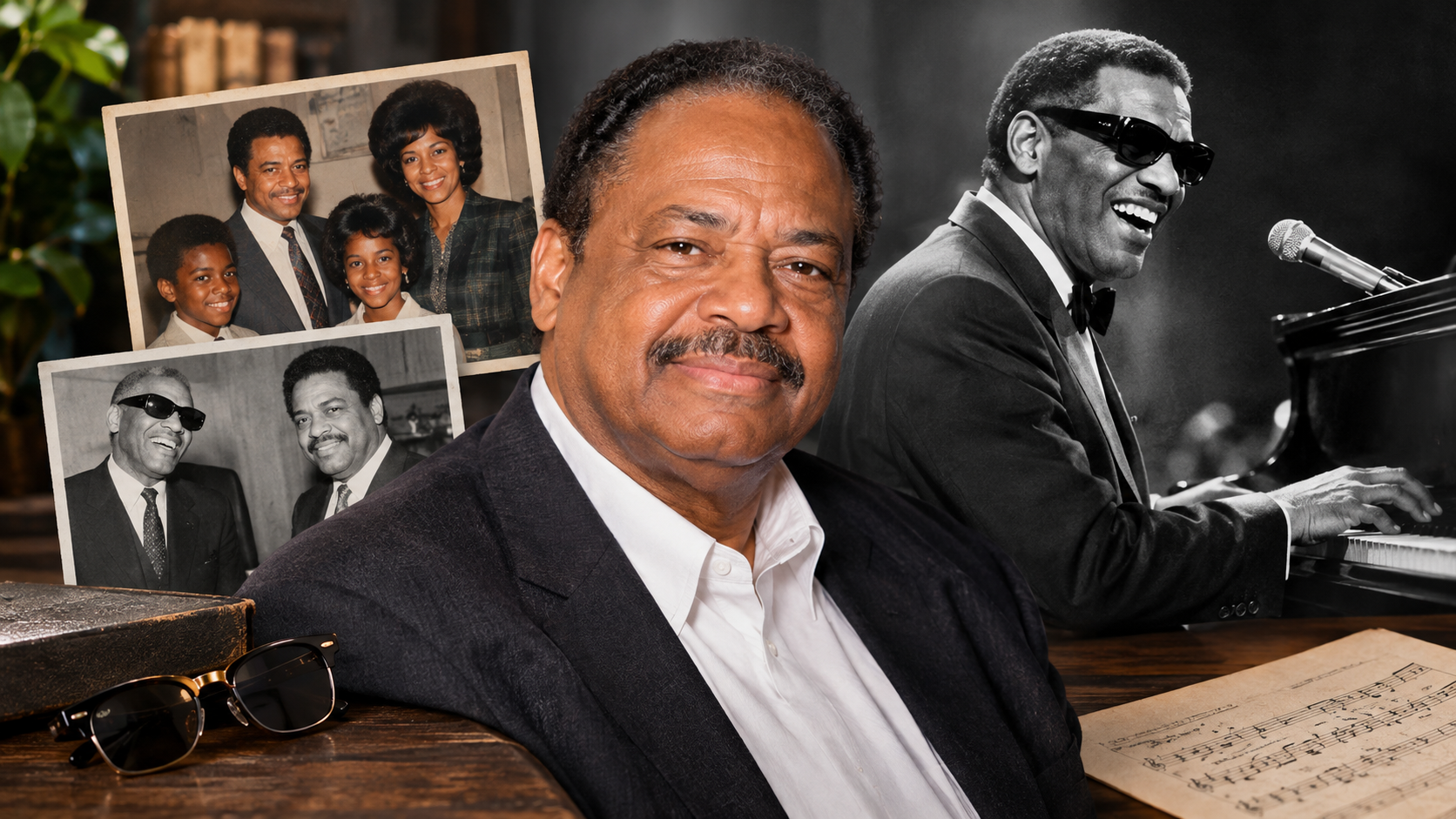
Searching for Charles Wayne Hendricks usually leads to questions about his connection to legendary musician Ray Charles. Charles Wayne Hendricks is identified in biographical and family-history sources as the son of Ray Charles and singer Margie Hendrix, a member of the Raelettes. He was born in 1959 and became one of Ray Charles’ 12 children.
Unlike his famous father and mother, Charles Wayne Hendricks did not establish a widely documented career in music or entertainment. Most publicly available information about him concerns his parentage, birth, family relationships, and connection to Ray Charles.
There is also an important identification issue. Another man named Charles Wayne Hendricks was born in 1946 in Oklahoma and died in August 2026 at age 79. His obituary describes a life in Anadarko and Binger, Oklahoma, and he was not the son of Ray Charles.
Because of this name overlap, a careful biography should distinguish between the two individuals rather than combining their life stories.
Direct Answer
Charles Wayne Hendricks is best known as the son of musician Ray Charles and singer Margie Hendrix. He was born on October 1, 1959, and was one of Ray Charles’ 12 children. His mother was associated with the Raelettes, Ray Charles’ backing vocal group. Unlike his parents, Charles Wayne lived largely outside public entertainment, so reliable details about his adult career and private life are limited.
Who Was Charles Wayne Hendricks?
Charles Wayne Hendricks is primarily known because of his place in the family of Ray Charles.
Ray Charles was one of the most influential American musicians of the 20th century, with a career spanning rhythm and blues, soul, gospel, jazz, blues, country, and pop. Margie Hendrix was also a professional singer and an important early member of the Raelettes.
Their relationship produced Charles Wayne in 1959. Historical accounts of Ray Charles’ family identify him as one of Ray’s 12 children.
The contrast between father and son is striking. Ray Charles spent decades performing before enormous audiences, recording music, appearing on television, and becoming an international cultural figure. Charles Wayne, by comparison, appears to have maintained a much lower public profile.
That limited public record is important when researching his life. There is enough information to establish his family connection and birth date, but not enough reliable evidence to construct a detailed account of every stage of his adult life.
Charles Wayne Hendricks’ Birth and Early Background
Charles Wayne Hendricks was born on October 1, 1959. His father was Ray Charles and his mother was Margie Hendrix. The date appears consistently in sources discussing Ray Charles’ children.
His birth occurred during an important period in his father’s career.
By 1959, Ray Charles was already an established recording artist. His music was reaching both rhythm-and-blues and mainstream audiences, and his work during this period helped establish the musical style that later became closely associated with soul music.
Margie Hendrix was also professionally involved in music. She was a founding member of the Raelettes, the vocal group associated with Ray Charles. She was known for her strong voice and contributed lead and backing vocals to recordings connected with Ray Charles.
This means Charles Wayne was born into a family already deeply connected to American popular music.
However, being born to famous performers did not make Charles Wayne a celebrity himself.
His Mother, Margie Hendrix
Understanding Charles Wayne’s background requires understanding his mother.
Margie Hendrix, whose name is also spelled Margie Hendricks in some sources, was an American rhythm-and-blues, gospel, jazz, and blues singer. She became closely associated with Ray Charles through the Raelettes.
She was born Marjorie Hendrix in Georgia in 1935 and became involved in professional music during the 1950s.
Before joining the Raelettes, she was associated with the Cookies. In 1958, the group evolved into the Raelettes, who became Ray Charles’ backing singers. Margie’s powerful vocal performances became an important part of the group’s sound.
One of the best-known recordings associated with this period is “Night Time Is the Right Time.” Historical accounts credit Margie Hendrix with prominent vocals on the recording, which reached No. 5 on the R&B chart.
Her relationship with Ray Charles was complicated, particularly because Charles was married to Della Bea Robinson during their relationship.
Margie’s life later became troubled by substance abuse and professional difficulties. She died in New York City in 1973 at age 38.
For Charles Wayne, this meant losing his mother while he was still a teenager.
Charles Wayne Hendricks and Ray Charles
The relationship between Charles Wayne and his father is one of the most frequently discussed parts of his biography.
Ray Charles acknowledged Charles Wayne as his son. Historical family accounts list him among Ray’s 12 children, born to nine different women.
Charles Wayne was born while Ray Charles was married to Della Bea Robinson. His birth therefore occurred within a complicated period of Ray Charles’ personal life.
Ray Charles’ family was unusually large. His children were born over several decades, and they came from different relationships. Charles Wayne was one of the older children in the family, born in 1959.
Later accounts of Ray Charles’ life describe his efforts to bring his children together. In 2002, Ray held a family luncheon for his 12 children, with 10 attending.
This family gathering is relevant because it shows that Charles Wayne was part of a much larger family network rather than being an isolated figure in Ray Charles’ biography.
How Many Siblings Did Charles Wayne Hendricks Have?
Charles Wayne Hendricks is generally identified as having 11 half-siblings through his father, Ray Charles.
Sources listing Ray Charles’ children identify the following family members:
- Evelyn Robinson
- Ray Charles Robinson Jr.
- David Robinson
- Charles Wayne Hendricks
- Robert Robinson
- Renee Robinson
- Sheila Robinson
- Reatha Butler
- Alexandra Bertrand
- Vincent Kotchounian
- Robyn Moffett
- Ryan Corey Robinson den Bok
These children were born to different mothers over several decades.
The family tree can therefore be confusing, especially because some siblings became public figures while others maintained relatively private lives.
Charles Wayne belongs to the less publicly documented side of the family.
Did Charles Wayne Hendricks Become a Musician?
There is no strong public record showing that Charles Wayne Hendricks established a major professional career as a musician.
This is an important distinction.
It would be easy to assume that the son of Ray Charles and Margie Hendrix must have entered the music business. But parentage does not establish profession.
Available biographical sources generally describe Charles Wayne as a private individual rather than a recording artist, performer, songwriter, or entertainer.
There are online claims about his adult life, employment, marriage, and family, but many of those details are not supported by sufficiently strong primary documentation.
A responsible biography therefore should not turn uncertain claims into established facts.
Why Is So Little Known About Charles Wayne Hendricks?
The simplest explanation is that he was not a public entertainer.
Ray Charles’ life generated extensive documentation because he spent decades performing, recording, touring, giving interviews, and receiving awards.
Charles Wayne did not have the same public career.
That creates a common problem in online biographies: when a person’s life is poorly documented, websites sometimes fill the gaps with information copied from other websites.
After enough repetition, an unsupported statement can begin to look like an established fact.
This is particularly relevant to searches about Charles Wayne Hendricks’:
- Wife
- Children
- Career
- Residence
- Net worth
- Death
- Cause of death
Some websites provide specific answers to these questions, but the evidence is not equally strong for all of them. Several recent biographies themselves acknowledge that important details of his adult life remain difficult to independently verify.
Was Charles Wayne Hendricks Married?
Online sources sometimes identify a woman named Marlene Hendricks as his wife.
However, this claim should be treated carefully.
A documented obituary exists for another man named Charles Wayne Hendricks, born in 1949, who was married to Marlene Hendricks and died in Colorado in 2013. The obituary lists his wife, children, stepchildren, and other relatives.
This is a crucial example of why identical-name records can create false biographies.
The Colorado obituary concerns a Charles Wayne Hendricks born in 1949, while Ray Charles’ son was born in 1959.
Therefore, information from that obituary should not automatically be assigned to Ray Charles’ son.
Did Charles Wayne Hendricks Die in 2013?
This is one of the most uncertain parts of the commonly published biography.
Several secondary websites state that Ray Charles’ son died in 2013.
However, the existence of a well-documented 2013 obituary for another Charles Wayne Hendricks makes the claim particularly difficult to verify.
The Colorado man was born October 19, 1949, and died May 7, 2013. His funeral-home record identifies him as a husband, father, stepfather, and Colorado resident.
That record does not establish that he was Ray Charles’ son.
At the same time, some biographical websites repeat 2013 as the death year of Ray Charles’ son without providing an authoritative obituary or primary record that clearly connects the death to the 1959-born Charles Wayne Hendricks.
For that reason, the most accurate wording is:
A 2013 death is widely reported online for Charles Wayne Hendricks, but the available public evidence should not be treated as conclusive proof that the 1959-born son of Ray Charles was the person who died in 2013.
This distinction is more useful than presenting an uncertain claim as fact.
What Happened to Charles Wayne Hendricks After His Mother’s Death?
Margie Hendrix died in July 1973. Charles Wayne was approximately 13 years old at the time.
Beyond that basic fact, detailed primary documentation of his teenage years is limited.
Some biographies claim that he was raised by relatives after his mother’s death. Others provide additional details about his relationship with Ray Charles.
These claims should be approached cautiously unless supported by a reliable family record or firsthand account.
There is nothing unusual about gaps in the biography of someone who was not a public figure. A teenager who grows up outside the entertainment industry may simply leave little searchable material behind.
Charles Wayne Hendricks and the Ray Charles Family Legacy
Although Charles Wayne did not become famous for a professional achievement of his own, his place in the Ray Charles family gives him historical relevance.
Ray Charles’ influence on American music is well established.
He helped bridge musical traditions that had often been separated by genre. Gospel, blues, jazz, rhythm and blues, country, and pop all became part of his distinctive musical identity.
Charles Wayne’s mother also had a meaningful place in that history through her work with the Raelettes.
As a result, Charles Wayne was born into a family connected to a major period of transformation in American popular music.
His story is therefore less about celebrity achievement and more about family history.
Why Charles Wayne Hendricks Is Often Called “Ray Charles’ Son”
Searches for Charles Wayne Hendricks frequently use phrases such as:
- Ray Charles’ son
- Ray Charles children
- Margie Hendrix son
- Charles Wayne Hendricks family
- Charles Wayne Hendricks biography
- Charles Wayne Hendricks age
- Charles Wayne Hendricks death
- Charles Wayne Hendricks mother
The reason is simple: his public identity is primarily connected to his parents.
Unlike a celebrity whose fame comes from a career, Charles Wayne’s name appears mainly in discussions of Ray Charles’ family tree and Margie Hendrix’s life.
That does not diminish his individual identity. It simply reflects what is publicly documented.
Common Misconceptions About Charles Wayne Hendricks
Misconception 1: Every online biography describes the same person
This is false.
There are multiple people named Charles Wayne Hendricks in public records. At least one Colorado obituary concerns a man born in 1949, while an Oklahoma obituary concerns a man born in 1946. Neither record establishes a connection to Ray Charles’ son.
Misconception 2: His career is well documented
It is not.
There is no substantial public entertainment career associated with Ray Charles’ son in the reliable material reviewed for this article.
Misconception 3: Repeated information is automatically verified
Not necessarily.
If ten websites repeat the same statement but all trace back to one unsupported source, repetition does not make the statement independently verified.
Misconception 4: A 2013 obituary proves that Ray Charles’ son died in 2013
It does not.
The documented 2013 obituary belongs to a different Charles Wayne Hendricks born in 1949.
Misconception 5: Being Ray Charles’ son means Charles Wayne was a musician
There is no sufficient evidence to make that assumption.
Parentage and profession are separate facts.
A Practical Way to Research Charles Wayne Hendricks
If you encounter conflicting information about Charles Wayne Hendricks, use this process.
Step 1: Check the Birth Date
The Ray Charles family connection is associated with October 1, 1959.
Step 2: Check the Parents
The relevant Charles Wayne Hendricks is identified as the son of Ray Charles and Margie Hendrix.
Step 3: Check the Location
Do not assume that every record with the same name belongs to him.
Step 4: Compare Relatives
Names of spouses, children, siblings, and parents can help separate individuals with identical names.
Step 5: Look for Primary Records
Funeral-home records, family announcements, contemporary news reports, and official documents are generally stronger evidence than copied biography pages.
Step 6: Label Uncertainty
If a fact cannot be independently established, describe it as reported or unconfirmed instead of presenting it as certain.
This method is useful not only for researching Charles Wayne Hendricks but for researching any relatively private person with a common name.
Key Facts About Charles Wayne Hendricks
- Full name: Charles Wayne Hendricks
- Birth date: October 1, 1959
- Father: Ray Charles
- Mother: Margie Hendrix
- Family connection: One of Ray Charles’ 12 children
- Mother’s musical group: The Raelettes
- Public career: No major, independently documented entertainment career identified
- Known primarily for: His connection to Ray Charles and Margie Hendrix
- Public biography: Limited
- Reported death year: 2013 in several secondary sources, but not sufficiently established by the evidence reviewed
- Important identification issue: Other people named Charles Wayne Hendricks appear in death and obituary records.
Frequently Asked Questions
Who is Charles Wayne Hendricks?
Charles Wayne Hendricks is known as the son of Ray Charles and singer Margie Hendrix. He was born on October 1, 1959, and is listed among Ray Charles’ 12 children.
Who was Charles Wayne Hendricks’ father?
His father was Ray Charles, the influential American singer, pianist, songwriter, and composer.
Who was Charles Wayne Hendricks’ mother?
His mother was Margie Hendrix, a rhythm-and-blues singer and member of the Raelettes, the backing vocal group associated with Ray Charles.
When was Charles Wayne Hendricks born?
The commonly documented birth date is October 1, 1959.
How many siblings did Charles Wayne Hendricks have?
He is generally described as one of Ray Charles’ 12 children, meaning he had 11 half-siblings through his father.
Was Charles Wayne Hendricks a musician?
There is no strong public evidence that he established a major music career comparable to that of his parents. His public identity is primarily associated with his family.
Was Charles Wayne Hendricks married?
Some online sources make claims about a wife, but those claims are difficult to establish independently. In particular, a 2013 obituary for another man named Charles Wayne Hendricks has sometimes created potential confusion.
Did Charles Wayne Hendricks die in 2013?
Several secondary websites report 2013, but this should be treated cautiously. A documented 2013 obituary concerns a different Charles Wayne Hendricks born in 1949. Stronger evidence is needed to confidently connect that death to Ray Charles’ son, who was born in 1959.
What happened to Margie Hendrix?
Margie Hendrix died in New York City on July 14, 1973, at age 38. She had been a member of the Raelettes and was the mother of Charles Wayne Hendricks.
Was Charles Wayne Hendricks Ray Charles’ only child?
No. Ray Charles had 12 children with multiple women. Charles Wayne was the child of Ray Charles and Margie Hendrix.
Why is there so little information about Charles Wayne Hendricks?
He was not a major public entertainer and appears to have lived largely outside the spotlight. As a result, there are far fewer interviews, professional records, and firsthand accounts than there are for his famous father.
Why are some Charles Wayne Hendricks biographies contradictory?
The main reason is limited documentation combined with an identical-name problem. Multiple people named Charles Wayne Hendricks appear in public records, and information about one person can be mistakenly attributed to another.
Key Takeaways
- Charles Wayne Hendricks is primarily known as Ray Charles’ son with Margie Hendrix.
- He was born on October 1, 1959.
- His mother, Margie Hendrix, was an important singer associated with the Raelettes.
- He was one of Ray Charles’ 12 children.
- Unlike his parents, Charles Wayne did not develop a widely documented public music career.
- Much of his adult life remains outside the reliable public record.
- Claims about his wife, children, career, and death should be evaluated carefully.
- The frequently repeated 2013 death claim is not sufficiently established by the evidence reviewed here.
- Multiple unrelated people named Charles Wayne Hendricks appear in public obituary records, making identity verification essential.
Conclusion
Charles Wayne Hendricks occupies an unusual place in the history surrounding Ray Charles. He was born into a family that had a major influence on American music, yet he did not become a public figure in the same way as his father or mother.
His father, Ray Charles, became an international musical icon, while his mother, Margie Hendrix, was a respected vocalist associated with the Raelettes. Charles Wayne therefore grew up connected to two important figures in rhythm and blues and soul music.
At the same time, the public record surrounding Charles Wayne himself is limited. That makes accuracy especially important. Information about his birth and parentage is relatively well established, while claims concerning his adult career, marriage, children, and reported death are less certain.
The identical-name problem adds another layer of difficulty. Public obituary records document other men named Charles Wayne Hendricks, including individuals who died in Colorado in 2013 and Oklahoma in 2026. Those records should not be automatically merged with the biography of Ray Charles’ son.
The most responsible way to understand Charles Wayne Hendricks is therefore to separate documented family history from later online speculation. What can be established is that he was born in 1959 to Ray Charles and Margie Hendrix and became part of one of the most recognizable musical families of the twentieth century. Much of the rest of his story remains private—and where the evidence ends, a trustworthy biography should say so.
Introduction
If you have searched for incfidelibus, you may have wondered whether it is an ancient Latin word, a religious expression, a philosophical concept, or simply an unusual term found online. The spelling certainly looks Latin, which makes it easy to assume that it must have a documented historical meaning.
There is, however, an important spelling issue.
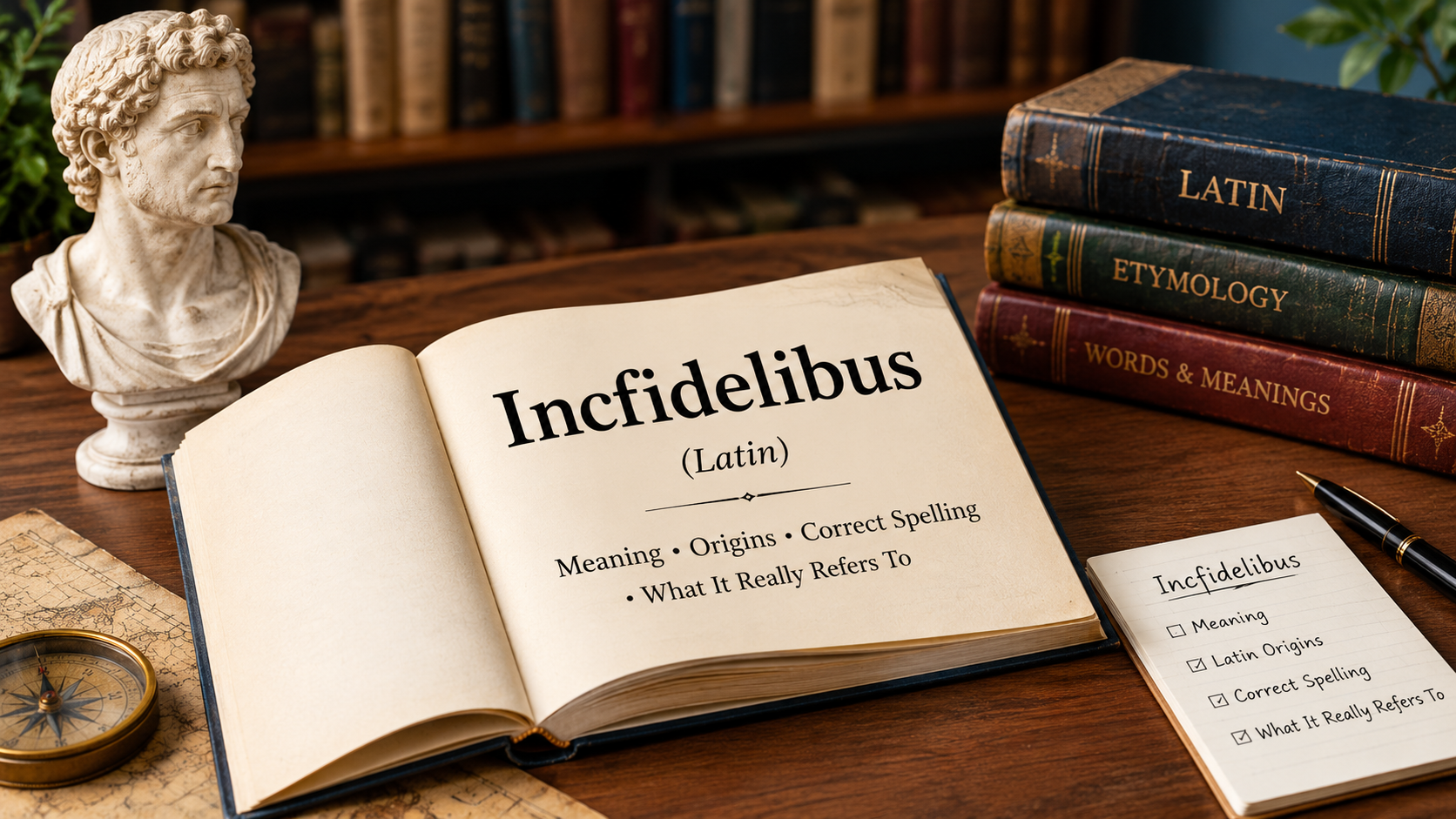
The form incfidelibus is not established as a standard Latin word in the major references examined. The closest documented form is infidelibus, which belongs to the Latin word family built around infidelis. Established Latin dictionaries define infidelis with meanings such as “unfaithful,” “faithless,” “not to be trusted,” and, in ecclesiastical Latin, “unbelieving” or “infidel.”
That one extra c changes how confidently the term can be interpreted. Rather than inventing a definition for incfidelibus, it is more accurate to examine the genuine Latin form and then consider why the unusual spelling appears online.
Direct Answer: What Does Incfidelibus Mean?
Incfidelibus does not have a securely established independent meaning as a standard Latin word. It closely resembles infidelibus, a genuine Latin form that is the dative or ablative plural of infidelis. Depending on context, infidelibus can refer to “the unfaithful,” “the faithless,” “the disloyal,” or “the unbelieving.” The extra c in incfidelibus is not part of the standard form.
What Is Incfidelibus?
The simplest way to understand incfidelibus is as an uncertain or non-standard spelling that resembles a genuine Latin word.
This distinction is important because a term appearing in search results does not automatically mean that it belongs to a historical language. The internet contains:
- Misspellings
- OCR errors
- Transcription mistakes
- User-created terms
- Altered spellings
- Copied information
- Usernames and website names
- Words reproduced without their original context
A search engine can index all of these.
Therefore, the fact that incfidelibus can be found online is not enough to establish it as an authentic Latin word.
The better-documented form is infidelibus, without the additional c.
Incfidelibus vs. Infidelibus
The difference becomes clearer when the two spellings are placed side by side.
| Term | Status | General interpretation |
| incfidelibus | Non-standard or uncertain | No securely established independent Latin definition |
| infidelibus | Documented Latin form | Dative/ablative plural of infidelis |
| infidelis | Documented Latin adjective | Unfaithful, faithless, unreliable; later also unbelieving |
The distinction is not merely cosmetic.
Latin uses grammatical endings to show how a word functions within a sentence. Infidelibus is a normal inflected form of infidelis, whereas the spelling incfidelibus does not have the same established grammatical basis. Latin dictionary resources identify infidelibus as the dative or ablative plural of infidelis.
The Latin Word Behind Incfidelibus: Infidelis
To understand the likely source of incfidelibus, start with infidelis.
The Lewis and Short Latin Dictionary defines infidelis as an adjective meaning “that cannot be relied upon,” “unfaithful,” or “faithless.” It also records a later ecclesiastical Latin meaning connected with being unbelieving or an infidel.
The Scaife ATLAS version of the Elementary Latin Dictionary likewise gives infidelis meanings including “not to be trusted, unfaithful, faithless.”
This is useful because it shows that the underlying word is much broader than the modern English word infidel might suggest.
In classical contexts, the word could concern:
- Trust
- Loyalty
- Reliability
- Faithfulness
- Disloyal behavior
In later Christian or ecclesiastical Latin, its meaning could develop toward:
- Unbelief
- Someone regarded as an unbeliever
- Religious infidelity
The surrounding sentence determines the best translation.
How the Word Is Formed
The relationship can be simplified as:
fides → fidelis → infidelis → infidelibus
Fides
Fides is a major Latin noun associated with concepts such as faith, trust, confidence, loyalty, and good faith.
Fidelis
From this word family comes fidelis, an adjective associated with being faithful or trustworthy.
Infidelis
The negative formation infidelis expresses the opposite idea: someone or something that is not faithful, trustworthy, or reliable.
Lewis and Short provides classical examples showing that infidelis was used well before the modern internet. Its examples include authors such as Cicero, Caesar, Horace, Plautus, and Pliny.
Infidelibus
Infidelibus is an inflected form of infidelis. Specifically, it can function as the dative plural or ablative plural for masculine, feminine, or neuter forms.
That means its English translation cannot always be reduced to one fixed phrase.
Depending on context, it can convey ideas such as:
- “to the unfaithful”
- “for the unfaithful”
- “by the unfaithful”
- “with the unfaithful”
- “among the unbelieving”
The exact translation depends on the sentence and historical context.
Why the Extra “C” Matters
The central mystery of incfidelibus is the letter c.
Compare:
infidelibus
with:
incfidelibus
The second form inserts a c after in. The standard word family does not require that letter.
This is why it is risky to describe incfidelibus as an alternative Latin spelling of infidelibus. The available dictionary evidence supports infidelis and its forms, including infidelibus, but does not establish incfidelibus as a normal Latin inflection.
A careful explanation therefore uses terms such as non-standard spelling, possible transcription error, or uncertain modern variant, rather than claiming that the word definitely has a separate ancient definition.
Is Incfidelibus a Real Latin Word?
Based on the available reference evidence, incfidelibus should not be treated as a standard Classical Latin or established ecclesiastical Latin word.
That does not necessarily prove that nobody has ever written the spelling. A misspelling can appear in manuscripts, scanned books, websites, databases, or other documents.
The important distinction is between:
“This spelling exists somewhere.”
and:
“This spelling is an established word in Latin.”
The first statement may be true without establishing the second.
For linguistic research, stronger evidence would include:
- A recognized Latin dictionary entry.
- Multiple reliable historical texts using the form intentionally.
- Manuscript evidence.
- Established grammatical analysis.
- Independent scholarly treatment of the spelling.
The documented evidence points instead toward infidelis → infidelibus.
Could Incfidelibus Be a Typographical Error?
Yes. A typo or transcription error is one plausible explanation, although the precise origin of the spelling cannot be established without finding the earliest source in which it appeared.
Several mechanisms can produce unusual spellings:
Typing mistakes
Someone may simply have inserted an extra letter while typing infidelibus.
OCR errors
Optical character recognition converts scanned pages into searchable text. When the original document is old, damaged, blurry, or printed in an unusual typeface, OCR can misread characters.
Transcription errors
A person copying text from an old document may reproduce a spelling incorrectly.
Repeated copying
Once an unusual spelling appears online, another website may copy it. A third website may then copy the second one.
After enough repetition, the spelling can begin to look authoritative even when the original error has never been verified.
Why Latin-Looking Words Can Be Misleading
Latin has a distinctive visual style. Words ending in forms such as -us, -is, -ibus, and -um can immediately appear historical or scholarly to modern readers.
That appearance, however, is not proof of authenticity.
Consider a hypothetical example.
Someone encounters the word incfidelibus on an unfamiliar webpage. The page says it is an ancient Roman philosophical term. A second page repeats the same explanation. A third page publishes an almost identical article.
It may look as though three sources confirm the claim.
But if all three copied the same original webpage, they are not independent evidence.
The better approach is to check the underlying language reference.
In this case, recognized Latin resources lead to infidelis and infidelibus, not to a well-established independent entry for incfidelibus.
Historical Meaning of Infidelis
The history of infidelis is more interesting than the unusual spelling itself.
The classical Latin meaning centered on a lack of faithfulness or reliability.
For example, Lewis and Short records uses connected with things or people that cannot be relied upon, along with meanings such as unfaithful and faithless.
Later, particularly in ecclesiastical Latin, the semantic field expanded toward unbelieving or infidel.
This development illustrates a common feature of language: words can acquire more specialized meanings as they move between periods, communities, and subjects.
Therefore, translating infidelis simply as “unbeliever” in every context would be too narrow.
What Does Infidelibus Mean in Grammar?
Infidelibus is not a separate root word. It is an inflected form.
Latin adjectives change their endings according to grammatical function, including:
- Case
- Number
- Gender
Infidelibus is a plural form that can serve the dative or ablative function for all three genders.
This is why a dictionary translation may offer several English possibilities rather than one fixed definition.
For example, depending on context, the dative can produce a meaning such as:
“to the unfaithful.”
An ablative construction could produce meanings closer to:
“by the unfaithful” or “with the unfaithful.”
Without the complete Latin sentence, choosing one translation with absolute certainty would be misleading.
Is Incfidelibus a Religious Term?
Not as an established term under that exact spelling.
However, its closest documented relative, infidelis, does have a religious sense in ecclesiastical Latin. Lewis and Short specifically records an ecclesiastical meaning involving “unbelieving” or “infidel.”
This distinction matters.
It would be inaccurate to say:
“Incfidelibus is an ancient religious term.”
A more defensible statement is:
“Incfidelibus resembles the documented Latin form infidelibus, which comes from infidelis, a word that acquired religious meanings in ecclesiastical Latin.”
That wording separates the uncertain spelling from the established historical vocabulary.
Does Incfidelibus Have a Philosophical Meaning?
There is no strong linguistic evidence establishing incfidelibus as the name of a recognized philosophical concept.
The underlying Latin word infidelis can relate to ideas such as trust, loyalty, faithfulness, and unbelief. Those concepts have obvious philosophical and ethical relevance, but that does not make incfidelibus itself a formal philosophical doctrine.
Readers should therefore be cautious when websites attach elaborate theories or specialized definitions to the spelling.
Does Incfidelibus Have a Hidden Meaning?
There is no reliable evidence that the unusual spelling contains a secret code or hidden ancient message.
Its appearance can certainly make it look mysterious, but mystery is not the same as historical significance.
The strongest linguistic explanation is much simpler: the spelling resembles infidelibus, a genuine Latin form, while the added c lacks an established grammatical explanation in standard Latin.
How to Check an Unfamiliar Latin Word
If you encounter incfidelibus or another unfamiliar Latin-looking term, you can investigate it systematically.
Step 1: Check the exact spelling
Do not immediately correct the word in your head. Record exactly what you saw.
Step 2: Remove possible typographical variations
Compare the word with nearby forms.
In this case:
incfidelibus → infidelibus
The difference is immediately visible.
Step 3: Find the dictionary headword
An inflected Latin word may not appear in a dictionary under the exact form you encountered.
For infidelibus, the underlying headword is infidelis.
Step 4: Check the grammar
Determine the case, number, and gender.
This helps explain why the word has its particular ending.
Step 5: Examine the original context
A single word can have different translations depending on the sentence.
Step 6: Prefer primary or scholarly references
A recognized Latin dictionary is stronger evidence than a website that simply repeats a definition from another website.
Common Mistakes When Researching Incfidelibus
Mistake 1: Treating every search result as evidence
Search engines organize information; they do not certify historical accuracy.
Mistake 2: Assuming unusual spelling means ancient origin
A word can look old without actually being ancient.
Mistake 3: Giving Incfidelibus its own invented definition
Because the spelling resembles Latin, writers may be tempted to construct a meaning for it. That goes beyond the evidence.
Mistake 4: Ignoring the extra “c”
The difference between infidelibus and incfidelibus is the central issue. It should not be dismissed as irrelevant.
Mistake 5: Translating infidelibus without context
Because Latin case endings carry grammatical information, a single English translation may not work in every sentence.
Mistake 6: Confusing online repetition with historical proof
Five websites repeating one claim do not necessarily provide five independent sources.
Real-World Example: Someone Finds Incfidelibus in a Document
Imagine that you find incfidelibus in an old-looking PDF.
It would be tempting to conclude that you have discovered an obscure Latin expression.
A better approach would be:
- Copy the exact word.
- Look for the surrounding sentence.
- Compare it with infidelibus.
- Search established Latin dictionaries for infidelis.
- Determine whether the document is an original historical source or a modern transcription.
- Check whether the apparent c could be an OCR or transcription error.
If the source turns out to be a scanned modern transcription, the unusual spelling becomes much less surprising.
What Should Writers Use: Incfidelibus or Infidelibus?
If you intend to refer to the documented Latin word, use “infidelibus,” not “incfidelibus.”
Infidelibus is supported by Latin reference material as a grammatical form of infidelis.
If you are specifically discussing the unusual spelling found online, then incfidelibus is appropriate as the object of discussion.
For example:
“The spelling incfidelibus is not established as a standard Latin form; it resembles the documented infidelibus.”
That preserves the distinction clearly.
Key Facts About Incfidelibus
- Incfidelibus is an unusual Latin-looking spelling.
- It does not have a securely established independent dictionary meaning as standard Latin.
- The closest documented form is infidelibus.
- Infidelibus comes from the Latin adjective infidelis.
- Infidelis can mean unfaithful, faithless, or not to be trusted.
- In ecclesiastical Latin, infidelis can also mean unbelieving or infidel.
- Infidelibus is a dative or ablative plural form.
- The extra c in incfidelibus is not part of the standard documented form.
- The unusual spelling could represent a typo, transcription issue, OCR error, later invention, or another undocumented usage.
- The exact origin of the spelling cannot be established without reliable evidence showing where it first appeared.
Frequently Asked Questions
What is the meaning of incfidelibus?
There is no securely established independent meaning for incfidelibus as a standard Latin word. It most closely resembles infidelibus, a documented Latin form associated with infidelis.
What does infidelibus mean?
Infidelibus is the dative or ablative plural of infidelis. Depending on context, it can convey meanings such as “to the unfaithful,” “for the unfaithful,” “by the unfaithful,” or “with the unfaithful.”
Is incfidelibus a real Latin word?
It is not established as a standard Latin word in the major reference material examined. The recognized related form is infidelibus, without the extra c.
Is infidelibus a Latin word?
Yes. Infidelibus is a documented inflected form of the Latin adjective infidelis.
What does infidelis mean?
Infidelis can mean “not to be trusted,” “unfaithful,” or “faithless.” In ecclesiastical Latin it can also carry the sense “unbelieving” or “infidel.”
Is incfidelibus an ancient religious word?
There is no reliable evidence establishing that exact spelling as a standard ancient religious term. The related word infidelis did acquire a religious sense in ecclesiastical Latin.
Why does incfidelibus look like Latin?
Its structure closely resembles a genuine Latin form, particularly infidelibus. Latin endings such as -ibus also make it visually convincing as an inflected Latin word.
Could incfidelibus be a typo?
Yes. A typographical, transcription, or OCR error is a plausible explanation. However, without identifying the earliest source, it is not possible to state exactly how the spelling originated.
What is the correct spelling?
If you mean the documented Latin word related to infidelis, the spelling is infidelibus.
Is infidelibus the same as the English word “infidel”?
They are related linguistically, but they are not identical grammatical forms. Infidelibus is an inflected Latin form, while “infidel” is an English noun/adjective derived through the historical development of the Latin word family.
Does incfidelibus have a hidden meaning?
There is no reliable evidence for a secret or coded meaning. The safest interpretation is that it is an uncertain spelling resembling infidelibus.
Key Takeaways
- Incfidelibus is not securely established as an independent Latin word.
- The closest authentic form is infidelibus.
- Infidelibus is derived from infidelis, a Latin adjective.
- Infidelis means things such as unfaithful, faithless, disloyal, or not to be trusted.
- Ecclesiastical Latin also uses infidelis in the sense of unbelieving or infidel.
- Infidelibus is a dative/ablative plural form.
- The extra c in incfidelibus has no established role in the standard Latin formation.
- The unusual spelling may have resulted from a typo, transcription problem, OCR error, or later online usage.
- Context is essential when translating infidelibus.
- When researching unusual words, established dictionaries and original texts are more reliable than repeated internet claims.
Conclusion
Incfidelibus is best approached as an uncertain Latin-looking spelling rather than as a confirmed ancient term with its own established definition. The documented linguistic trail leads to infidelibus, the dative or ablative plural of infidelis.
That underlying Latin word has a well-established history. Infidelis can describe someone or something that is unfaithful, faithless, unreliable, or not to be trusted, while later ecclesiastical usage developed a meaning connected with unbelief.
The distinction between incfidelibus and infidelibus is therefore the key to understanding the search term. Rather than assigning an invented meaning to the extra c, it is more accurate to acknowledge the uncertainty and examine the genuine Latin word behind the spelling.
If you have encountered the word fascisterne while reading Danish history, politics, news, or Scandinavian content, its meaning may not be immediately obvious. It looks similar to the English word “fascist,” but the ending changes how the word functions.
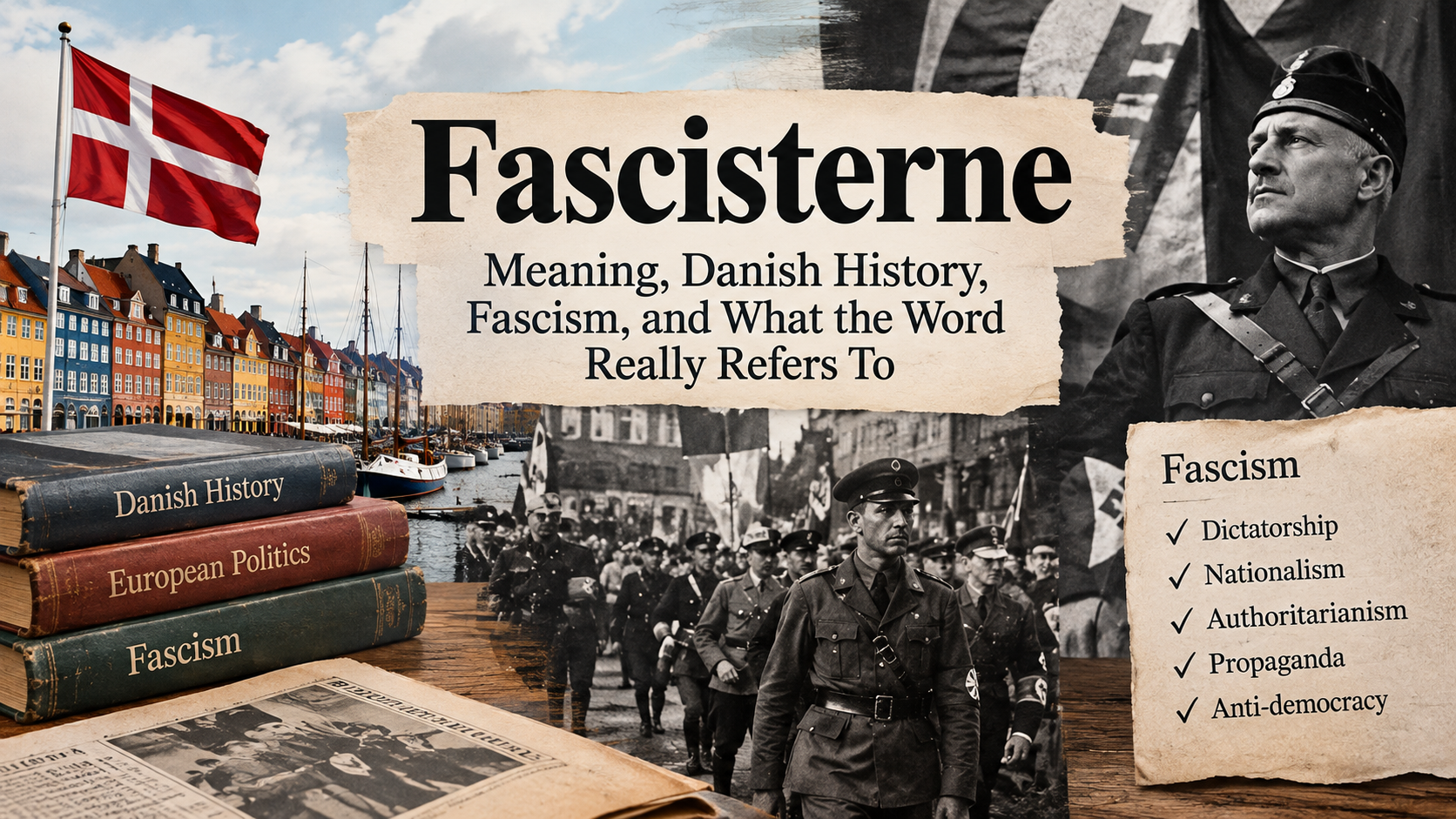
The simplest translation is “the fascists.” In Danish, fascisterne is the definite plural form of fascist. It refers to a particular or previously identified group of people described as fascists. It does not, by itself, name a political party, organization, or ideology.
Understanding that distinction is useful because fascisterne can appear in very different historical contexts. It may refer to Italian Fascists, Danish fascists, or another group identified as fascist. The surrounding sentence and historical setting determine who the writer means.
What Does Fascisterne Mean?
Fascisterne is a Danish word meaning “the fascists” in English. It is the definite plural form of fascist, which the Den Danske Ordbog defines as a supporter of fascism. The dictionary lists the relevant forms as fascist, fascisten, fascister, and fascisterne.
A simple breakdown is:
| Danish | English | Meaning |
| fascist | a fascist | One fascist |
| fascisten | the fascist | One specific fascist |
| fascister | fascists | Fascists in general |
| fascisterne | the fascists | A definite group of fascists |
| fascisme | fascism | The ideology or political movement |
The final -erne is a grammatical ending. It is not part of the name of a special political movement.
This is the most important point for anyone searching for fascisterne: the word itself does not identify one particular group.
Is Fascisterne a Political Party?
No.
Fascisterne is an ordinary Danish noun form. It is not, by itself, the official name of a political party or organization.
For example, if a Danish historian writes about fascisterne i Italien, the phrase can be understood as “the fascists in Italy.” If the discussion is about Denmark in the 1930s, fascisterne could refer to Danish fascists or Nazi activists depending on the specific context.
The surrounding text is therefore essential.
How the Danish Grammar Works
One reason the word can confuse English speakers is that Danish often expresses definiteness by changing the ending of a noun.
English usually uses a separate word:
the fascists
Danish can express the same idea through the noun ending:
fascisterne
The basic pattern is:
fascist → fascister → fascisterne
The first form refers to one fascist. The second is the ordinary plural. The third is the definite plural.
The Den Danske Ordbog records -en, -er, -erne as the relevant inflectional forms for fascist.
This grammatical detail matters when translating historical documents. A translator should not automatically turn fascisterne into the name of a specific movement.
Fascisterne vs. Fascisme
These two words are closely related but have different meanings.
Fascisterne refers to people.
Fascisme refers to fascism as a political ideology or movement.
The Den Danske Ordbog describes fascisme as a political movement that places the state and collective national interest above the individual and uses dictatorial methods against democratic principles. It also records broader modern uses connected with strongly nationalist or authoritarian politics.
A simple comparison makes the difference clear:
Fascisme = the ideology.
Fascisterne = the people described as fascists.
Confusing these terms can produce inaccurate translations or misleading historical explanations.
Where Does the Word Fascist Come From?
The Danish fascist ultimately traces its origin to Latin fascis, meaning a bundle of rods. The term became associated with the Roman fasces, a symbol of authority, and later with the political movement founded by Benito Mussolini in Italy.
Modern fascism emerged in Europe during the early twentieth century, particularly after the First World War.
The most famous early example was Italian Fascism, led by Benito Mussolini. Mussolini founded the Italian Fascist movement and eventually established a dictatorship in Italy. The United States Holocaust Memorial Museum describes fascism as a far-right, ultranationalist and authoritarian political philosophy that prioritizes the nation over the individual.
Mussolini’s political system became an important model for other authoritarian movements in Europe.
What Is Fascism?
Fascism is not simply another word for dictatorship or nationalism.
Historically, fascist movements have differed from one another, but several recurring characteristics help explain the term.
These can include:
- Extreme or exclusionary nationalism
- Strong opposition to liberal democracy
- Authoritarian leadership
- Suppression of political opposition
- Political violence or acceptance of violence
- Militarism or paramilitary organization
- Hostility toward pluralism
- Strong emphasis on national unity
- Restrictions on individual rights
- Propaganda and mass political mobilization
The Holocaust Encyclopedia describes fascism as an ultranationalist and authoritarian ideology that rejects democratic pluralism and places the national community above individual rights. Fascist movements have also commonly portrayed political opponents or minority groups as threats to national unity.
However, these characteristics should not be treated as a simple checklist for labeling every authoritarian or nationalist movement “fascist.” Historical classification requires attention to the movement’s ideology, organization, behavior, period, and political goals.
Benito Mussolini and the Rise of Italian Fascism
Benito Mussolini is central to the history behind the word fascist.
Mussolini began his political career as a socialist but moved toward Italian nationalism during the First World War. By the end of the war, he had embraced fascism. He became the dominant political figure in Italy after the Fascist movement’s rise to power in 1922.
Mussolini’s government gradually dismantled democratic institutions and developed a dictatorship centered on his leadership.
This history explains why the word fascist became associated with authoritarian nationalism, political violence, dictatorship, propaganda, and the suppression of political opposition.
It also explains why fascisterne may appear in historical discussions about Mussolini and his followers.
Fascisterne and Nazism: Are They the Same?
Not exactly.
Fascism and Nazism are closely related but should not automatically be treated as identical.
Italian Fascism developed under Mussolini, while German National Socialism developed under Adolf Hitler and the Nazi Party.
The two movements shared important features, including:
- Authoritarian leadership
- Extreme nationalism
- Anti-democratic politics
- Political repression
- Militarism
- Propaganda
- Opposition to communism and other political enemies
However, Nazi ideology placed a particularly central role on racial hierarchy, antisemitism, and the idea of a racially defined national community. The Nazi regime ultimately carried out the Holocaust and other forms of mass persecution and murder.
For that reason, translating every occurrence of fascisterne as “the Nazis” would be inaccurate.
The correct translation is normally “the fascists,” while the identity of the group must be determined from context.
Fascisterne in Danish History
The word has particular relevance in Denmark because Denmark developed its own fascist and Nazi movements during the interwar period and the Second World War.
One of the most important organizations was Danmarks Nationalsocialistiske Arbejderparti (DNSAP).
DNSAP was founded on November 16, 1930, by Cay Lembcke. It was strongly inspired by Adolf Hitler’s German Nazi Party, the NSDAP. Its program, organizational structure, symbolism, and rhetoric were heavily influenced by the German model.
The organization later came under the leadership of Frits Clausen, who became its leader in 1933.
What Did DNSAP Stand For?
DNSAP promoted a form of Danish National Socialism influenced heavily by German Nazism.
Its political program included elements such as:
- Anti-parliamentarianism
- Strong nationalism
- Antisemitism
- Authoritarian leadership
- Opposition to Marxism
- A racial conception of national community
Historical research from Denmark’s Lex describes the party as closely modeled on Hitler’s NSDAP, including its organizational structure, symbolism, and ideological program.
This makes DNSAP an important example when discussing fascist and Nazi politics in Denmark.
But it is still necessary to distinguish DNSAP from fascisterne.
DNSAP is the name of a particular organization.
Fascisterne is the Danish phrase meaning “the fascists.”
The two terms can overlap in a historical discussion, but they are not interchangeable.
How Successful Was DNSAP?
Despite its strong ideological commitment and close relationship with German National Socialism, DNSAP remained politically limited in Denmark.
The party entered the Danish parliament in 1939 after receiving about 1.8% of the vote and three seats. During the German occupation, its support increased, but it still received only about 2.1% of the vote and three seats in the 1943 election.
This is an important part of the historical picture.
The existence of a fascist or Nazi movement does not mean that the majority of the population supported it.
In Denmark, DNSAP never succeeded in becoming the dominant political force it hoped to become.
Fascist Movements During the German Occupation
Germany occupied Denmark from 1940 to 1945.
The occupation created new opportunities for DNSAP, which hoped that German support might eventually help it gain political power. However, those ambitions were not realized.
According to Danmarkshistorien | Lex, DNSAP remained dependent on Germany while also struggling with the contradiction between its claim to represent Danish nationalism and its close imitation of German National Socialism.
The party also participated in recruitment efforts for Waffen-SS and Frikorps Danmark. Such activities contributed to the perception of the organization as connected to German occupation interests.
The party’s political failure became particularly clear after the 1943 election.
After Denmark’s liberation in May 1945, DNSAP dissolved. Some members were later prosecuted for specific acts of collaboration, although party membership alone did not automatically result in criminal prosecution.
Why Context Matters When Translating Fascisterne
Suppose you find fascisterne in a Danish historical article.
Do not immediately assume it means:
- Nazis
- DNSAP
- Mussolini’s followers
- German soldiers
- Danish collaborators
Instead, look at the surrounding text.
A Practical Three-Step Method
Step 1: Identify the grammatical meaning.
Start with the direct translation:
fascisterne = the fascists
Step 2: Look for the group already identified in the text.
The preceding paragraphs may mention Italy, Mussolini, Denmark, DNSAP, Germany, or another movement.
Step 3: Confirm the historical context.
Check the date, location, organization, and political movement being discussed.
This approach prevents you from adding information that was not present in the original Danish sentence.
Is Every Fascist a Nazi?
No.
Nazism is a specific political ideology associated with Adolf Hitler’s German National Socialist movement.
Fascism is a broader historical category that includes different movements and political traditions.
Italian Fascism and German National Socialism shared important characteristics, but they developed in different national and historical settings.
Likewise, a Danish organization influenced by Nazism should not automatically be treated as identical to the German Nazi Party.
This distinction is especially important when translating historical material because a single political label can hide significant differences between movements.
How the Word Is Used in Modern Danish
The historical meaning remains the most important foundation, but fascist can also have a broader or figurative meaning.
The Den Danske Ordbog records a transferred sense for a person with strongly right-wing and nationalist ideas or someone who supports authoritarian suppression of people with different views.
That broader use means the word can appear in modern political arguments.
For example, someone may call a political opponent “fascist” because they believe that person’s policies are authoritarian.
But a political accusation is not automatically a historical classification.
Calling someone a fascist does not, by itself, demonstrate that the person belongs to a fascist movement.
This distinction is useful when evaluating modern political language.
Common Misconceptions About Fascisterne
Misconception 1: Fascisterne is the name of a political party
Incorrect.
It is a Danish grammatical form meaning “the fascists.”
A specific organization, such as DNSAP, has its own name.
Misconception 2: Fascisterne means fascism
Incorrect.
Fascisterne refers to people.
Fascisme refers to fascism.
Misconception 3: Fascisterne always means Nazis
Incorrect.
Nazism and fascism are historically connected but not identical.
The exact meaning depends on context.
Misconception 4: Every authoritarian politician is automatically fascist
Too simplistic.
Authoritarianism is an important part of fascist politics, but historical fascism has a wider set of ideological and political characteristics.
Misconception 5: The ending “-erne” is part of the political ideology
Incorrect.
The ending is grammatical. It marks the definite plural.
Real-World Examples of How Fascisterne Can Be Understood
Consider three hypothetical Danish sentences.
Example 1: Italian History
A historian writes about fascisterne i Italien.
The natural translation is:
“the fascists in Italy.”
The historical context would likely identify Mussolini’s Fascist movement.
Example 2: Danish History
A text discusses Danish political organizations during the 1930s and then uses fascisterne.
The word may refer to Danish fascists, but the surrounding text should establish exactly which movement or people are intended.
Example 3: Modern Political Debate
A person uses fascisterne in a political argument.
The translation remains “the fascists,” but the classification itself may be rhetorical rather than a carefully documented historical description.
These examples show why translation and interpretation are two different tasks.
Why Accurate Use of the Term Matters
Political terminology can shape how readers understand history.
If a translator changes fascisterne into “the Nazis” without evidence, the translation becomes more specific than the original.
If a general reference to fascists is turned into the name of a particular organization, the reader may assume a connection that the source never established.
Accuracy therefore requires separating three questions:
- What does the Danish word literally mean?
- Who does the writer mean in this particular passage?
- What historical evidence supports that identification?
This method is useful not only for fascisterne, but for political and historical terminology in general.
Key Facts About Fascisterne
- Fascisterne is Danish.
- Its direct English translation is “the fascists.”
- It is the definite plural form of fascist.
- The Danish word for fascism is fascisme.
- Fascisterne refers to people rather than the ideology itself.
- It is not automatically the name of a political organization.
- Its precise reference depends on the surrounding context.
- It can refer to historical fascists in Italy, Denmark, or elsewhere.
- It should not automatically be translated as “the Nazis.”
- The term can also be used more broadly in modern political language.
- Denmark had its own Nazi movement, including DNSAP, founded in 1930.
- DNSAP was strongly modeled on Hitler’s NSDAP but remained politically marginal in Denmark.
Frequently Asked Questions
What does fascisterne mean in English?
Fascisterne means “the fascists” in English. It is the definite plural form of the Danish noun fascist.
Is fascisterne a Danish word?
Yes. Fascisterne is a Danish noun form derived from fascist. The Danish dictionary records the inflectional forms that produce the definite plural.
What is the difference between fascisterne and fascisme?
Fascisterne means “the fascists” and refers to people. Fascisme means “fascism” and refers to the political ideology or movement.
Is Fascisterne the name of a political party?
No. The word itself is a grammatical noun form rather than the official name of a party or organization.
Does fascisterne always mean Nazis?
No. The term can refer to fascists generally. Nazism is a specific political movement associated with Hitler and the German Nazi Party. Context is needed to determine which group a Danish writer means.
Why does fascisterne end in -erne?
The -erne ending marks the definite plural in this form. It gives the word the meaning “the fascists.”
Who were the most famous fascists?
Benito Mussolini is the central historical figure associated with Italian Fascism. Adolf Hitler and the Nazi movement are also commonly discussed in the broader history of fascist politics, although Nazism has its own specific ideological and historical identity.
Did Denmark have fascists during the 1930s?
Yes. Denmark had fascist and Nazi political movements. DNSAP, founded in 1930, was the most important Danish Nazi party of the period and was heavily influenced by Hitler’s NSDAP.
Was DNSAP successful in Denmark?
It achieved limited parliamentary representation but never became a dominant political force. It won three seats in the 1939 and 1943 elections despite having thousands of members.
Can fascist be used as a modern political insult?
Yes, the word can be used rhetorically in modern political debates. However, a rhetorical accusation should not automatically be treated as a historically established description. The Danish dictionary itself records both the historical meaning and a broader transferred meaning.
Key Takeaways
- Fascisterne = “the fascists.”
- It is a Danish definite plural noun.
- It describes people, not the ideology of fascism.
- Fascisme = fascism, while fascisterne = the fascists.
- The word is not the official name of a particular political party.
- Context determines which fascists a Danish text is discussing.
- Fascism developed into major political movements in twentieth-century Europe, especially in Italy and Germany.
- Denmark also had a significant Nazi movement, especially DNSAP, during the 1930s and occupation period.
- Fascism and Nazism are related but should not simply be treated as identical.
- Careful translation is especially important when political labels are used in historical sources.
Conclusion
Fascisterne is best understood first as a Danish language term: “the fascists.” Its grammatical form tells us that the writer is referring to a definite group of people described as fascists, while the surrounding context tells us exactly who those people are.
The word connects naturally to the wider history of fascism, including Benito Mussolini’s movement in Italy, the rise of authoritarian and ultranationalist politics in interwar Europe, and the development of Nazi and fascist movements in other countries.
In Denmark, the term can be understood alongside the history of organizations such as DNSAP, which was founded in 1930 and closely modeled on Hitler’s German Nazi Party. Yet fascisterne should never automatically be treated as another name for DNSAP, Nazism, or any single political organization.


Masgonzola: What It Is, Ingredients, Taste, Uses, and How It Differs From Gorgonzola

Neworldsmagazine: What It Is, Topics, Website, Content, and What Readers Should Know

Nidia del Carmen Ripoll Torrado: Biography, Family, Shakira Connection, and Life

Kane Brown: The Life and Career of Country Music’s Genre-Blending Star

Lionel Messi: Career, Records, and Where He Stands in 2026

Jason Beck: Detroit Tigers Beat Reporter and One of Baseball’s Most Trusted Voices
-
 Business3 months ago
Kane Brown: The Life and Career of Country Music’s Genre-Blending Star
-
 Sports3 months ago
Lionel Messi: Career, Records, and Where He Stands in 2026
-
 Lifestyle4 months ago
Jason Beck: Detroit Tigers Beat Reporter and One of Baseball’s Most Trusted Voices
-

 Sports3 months ago
Gordon Ramsay’s Brother: Everything Known About Ronnie Ramsay
-

 News3 months ago
Amber Heard: Career, Legal History, and Where She Is Today
-

 News3 months ago
NCIS: What the Show Is About, How It Works, and Why It’s Still On the Air
-

 News3 months ago
Trump Tariffs Explained: What They Are, How They Work, and What They Mean for Prices in 2026
-
 News3 months ago
Patrick Muldoon: The Life and Career of the Days of Our Lives and Starship Troopers Actor