Arts
Up and Down Words: A Complete Guide to Direction-Based Vocabulary in English


Meta Description: Up and down words describe direction, movement, and change. Learn common up and down words, phrasal verbs, and idioms with clear examples.
What Are Up and Down Words?
Up and down words are terms built around the two opposite directions “up” and “down.” They show up as standalone words, phrasal verbs, and idioms, and they describe motion, change, emotion, and even business trends. English speakers use up and down words constantly, often without noticing how much work these small words do.
If you’ve ever heard someone say a stock “went up,” a mood “went down,” or a plan “fell through,” you’ve already run into this pattern. These pairs help English speakers talk about contrast: rising versus falling, gaining versus losing, starting versus stopping.
Direct Answer
Up and down words are English terms that pair the directional words “up” and “down” with verbs, nouns, or adjectives to describe movement, change, or state. Examples include “look up/look down,” “upturn/downturn,” and “uphill/downhill.” They appear in everyday speech, business language, weather reports, and idioms, and understanding them helps learners grasp both literal direction and figurative meaning.
Why Up and Down Words Matter
Direction words carry more meaning than their simple definitions suggest. “Up” often signals increase, improvement, or activation. “Down” often signals decrease, decline, or deactivation. This pattern isn’t random — it reflects how humans naturally associate vertical space with quantity and quality. More is up. Less is down. Good moods rise. Bad moods sink.
This matters for anyone learning English, writing clearly, or trying to understand native speakers in casual conversation, business meetings, or news reports. A single phrasal verb like “shut down” or “cheer up” can change the entire meaning of a sentence compared to its base verb.
Common Types of Up and Down Words
Phrasal Verbs
Phrasal verbs combine a base verb with “up” or “down” to create a new meaning that’s often different from the original verb.
- Look up – to search for information (different from simply “look”)
- Look down on – to view someone as inferior
- Break up – to end a relationship
- Break down – to stop functioning, or to become emotional
- Speak up – to talk more loudly or express an opinion
- Calm down – to become less upset
- Wake up – to stop sleeping
- Settle down – to become calm or to establish a stable life
Compound Nouns and Adjectives
Some up and down words merge into single compound terms.
- Upturn / downturn – an improvement or decline, often used for economies
- Uphill / downhill – ascending or descending, literally or figuratively (“things went downhill”)
- Upside / downside – the positive or negative aspect of a situation
- Upgrade / downgrade – to improve or reduce in rank, quality, or version
- Upright / downcast – standing straight or looking sad
Idioms and Figurative Expressions
Idioms take the literal direction and apply it to emotions, relationships, or abstract situations.
- Feeling up or down – describing mood
- Ups and downs – the normal mix of good and bad experiences in life
- On the up and up – acting honestly
- Down in the dumps – feeling sad
- Up in arms – angry or upset about something
How Up and Down Words Work in Sentences
Up and down words function in three main ways: as literal direction, as figurative meaning, and as intensifiers.
Literal direction describes physical movement. Example: “She walked up the stairs and then back down.”
Figurative meaning describes non-physical change. Example: “Sales were up 12% this quarter.”
Intensifiers add emphasis to an action without changing direction meaning much. Example: “Eat up your vegetables” doesn’t mean upward motion — it means finishing completely.
Recognizing which category a sentence falls into helps readers and learners avoid confusion, especially with phrasal verbs that don’t translate literally into other languages.
Common Mistakes People Make
Mistake 1: Translating literally from another language. Many languages don’t use directional particles the way English does. A learner might say “I look the word” instead of “I look up the word,” missing the phrasal verb entirely.
Mistake 2: Confusing similar-sounding phrasal verbs. “Break up” and “break down” look similar but mean very different things. One ends a relationship; the other means malfunction or emotional collapse.
Mistake 3: Assuming “up” always means positive and “down” always means negative. This is often true but not universal. “Wind down” (relax) is positive, while “act up” (misbehave) uses “up” negatively. Context decides the meaning, not just the direction word.
Mistake 4: Overusing idioms in formal writing. Idioms like “ups and downs” work fine in conversation but can feel too casual in academic or professional writing, where a more precise word may fit better.
Real-World Examples
Business context: “The company reported an upturn in quarterly earnings after last year’s downturn.”
Emotional context: “He’s had his ups and downs since the move, but he’s settling down now.”
Everyday conversation: “Can you turn the volume up? I can barely hear it. Actually, turn it down a little — that’s too loud.”
Weather and nature: “Temperatures are expected to go down tonight after climbing up throughout the afternoon.”
These examples show how the same small set of words adapts to completely different situations while keeping a consistent directional logic.
Key Facts
- Up and down words include phrasal verbs, compound words, and idioms.
- “Up” generally suggests increase, activation, or improvement.
- “Down” generally suggests decrease, deactivation, or decline.
- Meaning often depends on context, not just the direction word itself.
- These words appear across business, weather, emotional, and everyday language.
- Non-native English speakers often find phrasal verbs with “up” and “down” challenging because they don’t always translate literally.
Frequently Asked Questions
What are up and down words?
They are English terms — phrasal verbs, compound words, and idioms — that use “up” and “down” to express direction, change, or state, both literally and figuratively.
How do up and down words work in English grammar?
They typically combine with verbs to form phrasal verbs (look up, calm down) or merge into compound nouns and adjectives (upturn, downhill). Meaning often shifts significantly from the base verb alone.
Why is “up” usually positive and “down” usually negative?
This reflects a common but not absolute pattern in English where vertical position maps onto quantity, quality, or mood. Exceptions exist, so context always matters.
Are up and down words only used in casual speech?
No. While some idioms are casual, terms like “upturn,” “downgrade,” and “downside” appear regularly in formal business, financial, and news writing.
What’s the best way to learn up and down phrasal verbs?
Learning them in context — through real sentences, dialogues, or reading — tends to work better than memorizing definitions alone, since meaning often depends on usage rather than the individual words.
Do other languages have similar direction-based word patterns?
Many languages use directional particles or prefixes in similar ways, though the specific meanings and combinations differ. English relies especially heavily on phrasal verbs for this purpose.
Key Takeaways
- Up and down words describe direction, change, mood, and business trends.
- They appear as phrasal verbs, compound words, and idioms.
- “Up” often signals increase or improvement; “down” often signals decrease or decline, though exceptions exist.
- Context determines meaning more than the direction word alone.
- These words are common in everyday speech, formal writing, and business language alike.
Summary
Up and down words form one of the most practical and frequently used patterns in English. From casual conversation to financial reports, these small directional words carry outsized meaning. Understanding how they function — literally, figuratively, and idiomatically — makes both everyday conversation and more formal English easier to read, write, and understand.

Introduction
Masgonzola is a food term that can be confusing at first. It sounds like the name of a traditional Italian cheese, yet it is not as familiar as Gorgonzola, mascarpone, mozzarella, or Parmesan.
The explanation is much simpler: documented culinary use of the name Masgonzola refers to a combination of Gorgonzola and mascarpone. Betty Bossi, a long-established Swiss recipe publisher, uses the term in recipes and explicitly describes it as Gorgonzola with mascarpone. Its recipes use Masgonzola in dishes such as blinis, risotto, pizza, and filled pasta.
That distinction matters because Masgonzola should not automatically be presented as a separate historic cheese with its own protected designation. Gorgonzola itself is a protected Italian PDO cheese under European Union rules, while the evidence reviewed here does not establish a separate PDO category called Masgonzola.
So what exactly is Masgonzola? How does it taste? Is it a real cheese? How is it made, and how can it be used in cooking?
Direct Answer: What Is Masgonzola?
Masgonzola is a creamy cheese preparation made from Gorgonzola and mascarpone. The two cheeses combine the distinctive salty, tangy character of blue-veined Gorgonzola with the soft, rich texture of mascarpone. Documented recipes use Masgonzola as a combined ingredient in dishes such as risotto, blinis, pizza, sauces, and filled pasta. It is better understood as a cheese combination or specialty than as a separate protected cheese category.
What Does Masgonzola Mean?
The simplest way to understand the word is to look at the two cheeses behind it:
Mascarpone + Gorgonzola = Masgonzola
The name combines recognizable parts of the two cheese names.
More importantly, the term has documented culinary use. Betty Bossi’s French-language recipe for Masgonzola blinis describes it directly as Gorgonzola with mascarpone. Its English-language-equivalent culinary material and other Betty Bossi publications also use Masgonzola as an ingredient in several recipes.
This provides stronger evidence than websites that simply describe Masgonzola as an invented internet word.
Is Masgonzola a Real Cheese?
The short answer
Yes, the underlying cheese combination is real and the name has documented culinary use.
But there is an important qualification.
Masgonzola is not established in the sources reviewed as a separate protected cheese designation comparable to Gorgonzola PDO. It is more accurate to describe it as a Gorgonzola-mascarpone specialty or preparation.
Betty Bossi has published recipes that specifically use Masgonzola and explain its composition. One recipe describes Masgonzola as a creamy Italian soft cheese with alternating layers of Gorgonzola and mascarpone.
Another Betty Bossi recipe uses Masgonzola as a substitute for separate Gorgonzola and mascarpone in risotto.
So there is solid evidence that the term is used in actual food preparation rather than existing only as a recent internet invention.
Is Masgonzola the Same as Gorgonzola?
No.
This is one of the most common points of confusion.
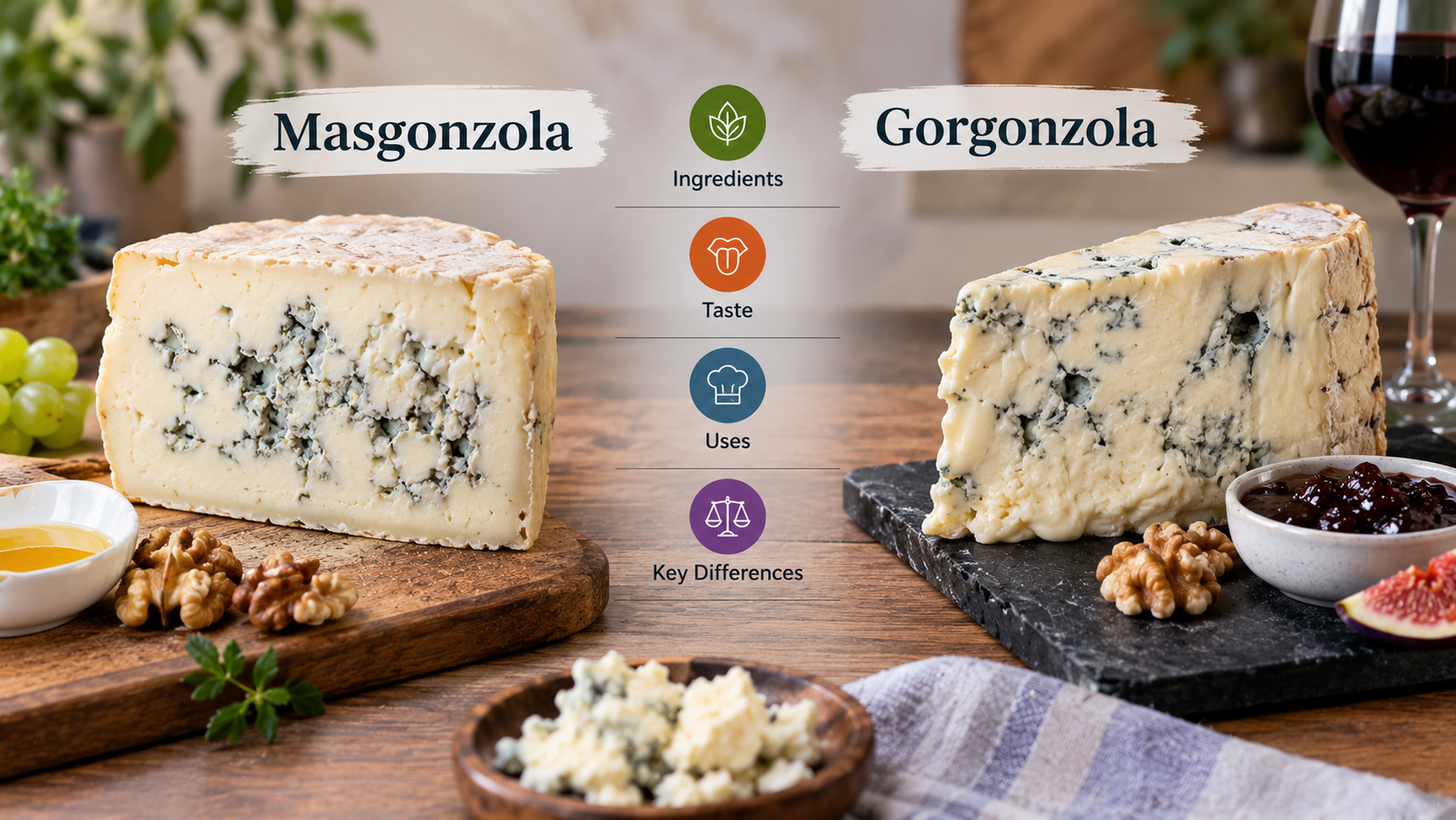
Gorgonzola is an established Italian blue-veined cheese with PDO protection in the European Union. European Union documentation specifies Gorgonzola as a blue-veined cheese made from pasteurized whole cow’s milk and sets out requirements concerning production, characteristics, labeling, and geographical area.
Masgonzola, by comparison, combines Gorgonzola with mascarpone.
The difference can be summarized simply:
| Feature | Masgonzola | Gorgonzola |
| Main components | Gorgonzola + mascarpone | Gorgonzola |
| Texture | Creamier and softer | Depends on type, generally firmer |
| Blue-cheese character | Softened by mascarpone | More pronounced |
| PDO status | No separate Masgonzola PDO established | EU PDO |
| Typical role | Blend, layered cheese, cooking ingredient | Standalone cheese and cooking ingredient |
| Common uses | Sauces, risotto, pasta, pizza, appetizers | Cheese boards, pasta, risotto, sauces and more |
The important point is that Masgonzola uses Gorgonzola as one of its components; the names are therefore related but not interchangeable.
What Is Gorgonzola?
Understanding Gorgonzola makes Masgonzola much easier to understand.
Gorgonzola is an Italian blue-veined cheese. Its official EU specification identifies it as a PDO product and describes its characteristic blue-green or grey-blue veining caused by mold development.
The European specification also recognizes different Gorgonzola types based on size, flavor, and maturation. Some are milder, while others have a stronger taste and longer maturation period.
That strong and distinctive cheese character is useful in cooking, but it can also be intense for people who prefer mild cheeses.
This is where mascarpone changes the experience.
What Is Mascarpone?
Mascarpone is a soft, rich Italian dairy product with a mild flavor and smooth consistency.
Unlike Gorgonzola, it does not have the strong blue-cheese character that defines the flavor of Masgonzola.
When mascarpone is combined with Gorgonzola, it contributes:
- Creaminess
- Richness
- A mild dairy flavor
- Soft texture
- A smoother mouthfeel
Gorgonzola contributes the stronger elements:
- Tanginess
- Saltiness
- Savory flavor
- Blue-cheese aroma
- Distinctive veining and character
Together, they produce a combination that is much creamier than plain Gorgonzola.
What Does Masgonzola Taste Like?
Masgonzola generally tastes rich, creamy, savory, salty, and tangy, with the strength depending on the proportion and type of Gorgonzola used.
The easiest comparison is to imagine turning down the intensity of blue cheese without removing its identity.
Gorgonzola gives the mixture its recognizable blue-cheese personality. Mascarpone adds a softer, richer base that makes the overall texture smoother.
That balance can make Masgonzola useful for people who enjoy the flavor of blue cheese but find a strong blue cheese too aggressive on its own.
The Flavor Balance
Think of the two ingredients as playing different roles.
Gorgonzola provides the personality.
Mascarpone provides the softness.
If a preparation contains more Gorgonzola, the result can be more savory and pronounced. If it contains more mascarpone, the mixture will generally feel milder and creamier.
There is no single universal Masgonzola formula established by the sources reviewed, so the exact taste can vary by product or preparation.
What Does Masgonzola Look Like?
A Masgonzola-style preparation can have a distinctive appearance because the two components may remain visible.
Some versions can contain alternating layers of:
- White or pale mascarpone
- Blue-veined Gorgonzola
Betty Bossi specifically describes Masgonzola as a layered cheese made from Gorgonzola and mascarpone in one of its recipes.
Other preparations may be mixed more thoroughly.
This means there is no reason to expect every Masgonzola product to look exactly the same.
How Is Masgonzola Made?
There is no single universal production method established for Masgonzola as a protected cheese category.
Instead, the documented examples show that Gorgonzola and mascarpone can be combined or layered.
Method 1: Layering
One approach is to place layers of Gorgonzola and mascarpone together.
This preserves some visual distinction between the two components.
Betty Bossi describes Masgonzola as a layered cheese in its recipe material.
Method 2: Combining the Cheeses in a Dish
Another approach is to add both ingredients directly to a recipe.
For example, Betty Bossi’s Gorgonzola risotto uses Gorgonzola and mascarpone together and gives Masgonzola as a suggested substitute for the two separate ingredients.
Why Combine Them?
The reason is mainly culinary.
Gorgonzola provides a strong savory flavor, while mascarpone contributes richness and smoothness.
Instead of choosing between a mild creamy cheese and a powerful blue cheese, the combination brings characteristics of both into one ingredient.
How Is Masgonzola Used in Cooking?
Masgonzola is particularly useful in recipes where a creamy cheese with a noticeable savory character is desirable.
Documented Betty Bossi recipes show several practical uses.
Masgonzola in Risotto
Risotto is one of the clearest examples.
A Betty Bossi Gorgonzola risotto recipe combines Gorgonzola and mascarpone and specifically suggests replacing both with 200 grams of Masgonzola.
The result fits the basic role of the two ingredients: the cheese contributes richness while also adding a pronounced savory flavor.
Masgonzola on Blinis
Betty Bossi also publishes a Masgonzola blini recipe.
The recipe uses Masgonzola with pesto, chervil, and caramelized or smoked almonds.
This is a useful example of how the cheese can work as a topping or appetizer ingredient rather than simply being melted into a main dish.
Masgonzola on Pizza
Betty Bossi recipe material also lists Masgonzola on a spinach and leek pizza.
The recipe uses Masgonzola alongside leek, young spinach, Gruyère, and radishes. It even suggests mascarpone or crème fraîche as an alternative.
That demonstrates the ingredient’s role as a creamy cheese component in savory baking.
Masgonzola in Filled Pasta
Another Betty Bossi recipe uses Masgonzola with ham in filled pasta known as ravioli crowns.
The filling combines ham and Masgonzola before being enclosed in pasta.
Masgonzola Sauce
Masgonzola can also be melted into a sauce.
A Betty Bossi recipe for salmon with Masgonzola sauce uses the cheese with milk, vegetable broth, lemon, dill, and other ingredients. The recipe again describes Masgonzola as a layered cheese made from Gorgonzola and mascarpone.
This shows why the combination works well in sauces: it can provide both creaminess and strong cheese flavor.
What Foods Pair Well With Masgonzola?
Because Masgonzola combines richness with blue-cheese character, it can pair well with foods that either complement or balance those qualities.
Fruit
Sweet or mildly acidic fruit can provide contrast.
Potential pairings include:
- Pears
- Apples
- Figs
- Grapes
The sweetness and acidity can balance the salty character of the cheese.
Nuts
Nuts can add texture and earthy flavor.
Good examples include:
- Walnuts
- Almonds
- Hazelnuts
Betty Bossi’s Masgonzola blini recipe, for example, uses caramelized or smoked almonds.
Bread and Crackers
Because Masgonzola can be soft and creamy, it can work well with bread, toast, crackers, or similar foods.
The neutral base allows the cheese to remain the main flavor.
Vegetables
Leafy greens and vegetables can also work well with the cheese.
Betty Bossi’s recipes demonstrate combinations involving spinach, leek, and radishes.
Masgonzola vs. Mascarpone
Masgonzola and mascarpone are not the same thing.
Mascarpone is one of the ingredients used to create Masgonzola.
Mascarpone has a mild flavor and creamy texture. Masgonzola has a more pronounced savory and blue-cheese character because it contains Gorgonzola.
A simple way to remember the difference is:
Mascarpone is one component; Masgonzola is the combination.
That distinction is especially useful when reading recipes.
Masgonzola vs. Blue Cheese
Masgonzola can be considered blue-cheese-forward because Gorgonzola is part of the mixture, but it is not simply another name for blue cheese.
Traditional blue cheeses can vary widely in strength, texture, milk type, and production method.
Masgonzola is more specific because its documented culinary identity centers on the combination of Gorgonzola and mascarpone.
This makes it particularly useful when a recipe needs both blue-cheese flavor and a creamy consistency.
Does Masgonzola Have PDO Status?
There is no separate Masgonzola PDO established in the sources reviewed.
This distinction is significant.
The European Union formally recognizes Gorgonzola as a PDO cheese and has published detailed specifications covering its production, labeling, and geographical area.
The official specification identifies Gorgonzola as an Italian PDO product and sets requirements for how authentic Gorgonzola is produced and identified.
Masgonzola, meanwhile, appears in culinary usage as a combination involving Gorgonzola and mascarpone.
Therefore, calling Masgonzola a separate protected Italian cheese would go beyond the available evidence.
Is Masgonzola an Ancient Italian Cheese?
There is not enough reliable evidence to support describing Masgonzola as an ancient cheese with a centuries-old independent tradition.
The documented evidence is much more straightforward.
Betty Bossi has used the term in recipes and describes it through its Gorgonzola-and-mascarpone composition. Historical Coop publications also show that a product called Coop Masgonzola was sold in Switzerland, demonstrating that the term has been used commercially as well.
That is useful evidence, but it does not establish a separate ancient cheese-making tradition.
A responsible description is therefore:
Masgonzola is a documented culinary and commercial term for a Gorgonzola-and-mascarpone cheese combination.
Is Masgonzola Still Relevant Today?
Yes, at least as a culinary term.
Current and archived recipe material demonstrates that Masgonzola has been used in practical food preparation for years. Betty Bossi continues to have recipes using the name, while older Swiss commercial material also records Masgonzola as a packaged product.
Its usefulness comes from the simple culinary problem it solves.
Some dishes need the distinctive flavor of Gorgonzola but also benefit from a softer, creamier texture.
Combining Gorgonzola with mascarpone addresses both needs.
A Practical Example: Choosing Masgonzola for Risotto
Imagine you are preparing a creamy risotto.
You want:
- A strong cheese flavor
- A creamy texture
- Enough richness to finish the dish
- A cheese that melts into the rice
You could use Gorgonzola and mascarpone separately.
Or, where an appropriate Masgonzola product is available, you can use the combined ingredient.
That is exactly the substitution Betty Bossi presents in its Gorgonzola risotto recipe.
This example explains the practical value of the term better than a complicated definition does.
Step-by-Step: How to Understand a Masgonzola Product
If you encounter Masgonzola at a specialty food counter or in a recipe, use this simple process.
Step 1: Check the Ingredients
Look for Gorgonzola and mascarpone.
These are the two components most directly associated with the documented culinary use of Masgonzola.
Step 2: Check the Texture
A Masgonzola-style product may be soft, creamy, or layered.
Do not assume that every product will have the same appearance.
Step 3: Check the Label
The product may use the word Masgonzola, or it may be described more literally as Gorgonzola with mascarpone.
Step 4: Identify the Recipe’s Intended Role
Determine whether the cheese is being used as:
- A spread
- A sauce ingredient
- A pasta filling
- A pizza topping
- A risotto ingredient
- An appetizer component
Step 5: Consider the Strength of the Cheese
If you prefer mild flavors, a more mascarpone-heavy preparation may be easier to enjoy.
If you like strong blue cheese, a preparation with a more pronounced Gorgonzola character may suit you better.
Common Mistakes and Misconceptions
Mistake 1: Treating Masgonzola as another name for Gorgonzola
It is not.
Masgonzola combines Gorgonzola with mascarpone.
Mistake 2: Assuming every Masgonzola product has the same formula
There is no single universal formulation established in the sources reviewed.
The appearance, ratio, and texture can vary.
Mistake 3: Calling Masgonzola a separate PDO cheese
Gorgonzola has PDO status. The evidence does not establish a separate Masgonzola PDO.
Mistake 4: Assuming the term is simply an internet invention
That is also inaccurate.
Betty Bossi has documented recipes using Masgonzola, and historical Swiss commercial publications show the term being used for a packaged product.
Mistake 5: Assuming Masgonzola must always be layered
Some documented descriptions refer to alternating layers, but recipes can also use Masgonzola directly as an ingredient.
The exact form depends on the product or preparation.
Health and Nutrition Considerations
Masgonzola is a dairy-based cheese preparation, so its nutritional profile depends on the specific Gorgonzola-to-mascarpone ratio and serving size.
It should not automatically be described as a “healthy” or “unhealthy” food.
A more useful approach is to consider what is actually being eaten.
Cheese can contribute protein, fat, calories, and minerals, but portions can also be energy-dense.
For someone tracking calories or saturated fat, serving size matters.
For someone with a milk allergy, Masgonzola is not appropriate because both of its main components are dairy products.
People following a medically prescribed diet should rely on the specific product label and advice from an appropriate healthcare professional rather than assuming that every Masgonzola preparation has identical nutritional values.
Storage and Food Safety
Because Masgonzola is a fresh or soft dairy-based preparation, storage matters.
If you purchase a packaged product, follow the manufacturer’s refrigeration instructions and use the product within the stated period.
Do not rely on a generic storage period when the packaging provides a specific one.
For an opened product, keep it refrigerated and use clean utensils when serving it. If there is an unusual smell, visible spoilage, damaged packaging, or other clear sign that the product has deteriorated, it should not be consumed.
The exact shelf life depends on the manufacturer, packaging, ingredients, and handling conditions.
Where Does the Name Come From?
The most straightforward explanation is that the name combines parts of mascarpone and Gorgonzola.
This interpretation is supported by the way culinary publishers use the term.
For example, Betty Bossi’s French recipe explicitly describes Masgonzola as “gorgonzola au mascarpone,” while its German recipe materials identify it through the same two ingredients.
There is therefore little need to assign an elaborate hidden meaning to the word.
Its name is descriptive.
Key Facts About Masgonzola
- Masgonzola is a documented culinary term.
- It generally refers to a combination of Gorgonzola and mascarpone.
- Betty Bossi recipes explicitly identify Masgonzola with this combination.
- It can be layered or incorporated into dishes.
- Its texture is generally softer and creamier than plain Gorgonzola.
- Gorgonzola provides the stronger blue-cheese flavor.
- Mascarpone contributes richness and creaminess.
- Documented uses include risotto, blinis, pizza, sauces, and filled pasta.
- Gorgonzola is an EU-protected PDO cheese.
- No separate Masgonzola PDO has been established in the sources reviewed.
- The term has historical commercial evidence in Swiss food publications.
Frequently Asked Questions
What is Masgonzola?
Masgonzola is a cheese combination made from Gorgonzola and mascarpone. It combines the stronger savory and blue-cheese character of Gorgonzola with the smooth, creamy texture of mascarpone.
Is Masgonzola a real cheese?
The term has documented culinary and commercial use. It is best described as a cheese combination or specialty rather than as a separately protected cheese category.
Is Masgonzola the same as Gorgonzola?
No. Gorgonzola is one of the components of Masgonzola. Masgonzola adds mascarpone to Gorgonzola.
Is Masgonzola the same as mascarpone?
No. Mascarpone is the mild, creamy cheese used with Gorgonzola to create the Masgonzola combination.
Does Masgonzola have PDO status?
The sources reviewed establish PDO status for Gorgonzola, not a separate PDO designation for Masgonzola.
What does Masgonzola taste like?
It is generally creamy, rich, salty, tangy, and savory. The exact intensity depends on the type and amount of Gorgonzola used.
How is Masgonzola used?
It can be used in risotto, pasta, sauces, pizza, appetizers, filled pasta, and other savory dishes. Betty Bossi provides examples across several of these categories.
Can Masgonzola replace Gorgonzola and mascarpone separately?
In some recipes, yes. Betty Bossi’s Gorgonzola risotto specifically suggests replacing the separate Gorgonzola and mascarpone with 200 grams of Masgonzola.
Is Masgonzola suitable for people with a milk allergy?
No. Its primary components are dairy products, so anyone with a milk allergy should avoid it unless a qualified medical professional has confirmed otherwise.
Why is Masgonzola less intense than some Gorgonzola?
Mascarpone contributes a mild and creamy element that balances the stronger flavor of Gorgonzola. The final intensity also depends on the specific product and ratio.
Can Masgonzola be used on pizza?
Yes. Betty Bossi recipe material documents Masgonzola being used on a pizza with leek, spinach, Gruyère, and radishes.
Can Masgonzola be used in pasta?
Yes. Documented recipes use it in filled pasta and creamy sauces.
Key Takeaways
- Masgonzola is best understood as a Gorgonzola-and-mascarpone cheese combination.
- Its name likely reflects the combination of “mascarpone” and “Gorgonzola.”
- It is not simply another name for Gorgonzola.
- Gorgonzola has formal EU PDO protection; Masgonzola does not have a separate PDO designation established by the sources reviewed.
- The combination is supported by actual culinary evidence rather than only recent online articles.
- Betty Bossi uses Masgonzola in recipes for blinis, risotto, pizza, filled pasta, and sauces.
- Its main culinary advantage is the balance between blue-cheese flavor and creamy texture.
- Exact flavor, texture, and nutritional values can vary according to the product and proportions of Gorgonzola and mascarpone.
- Claims that Masgonzola is an ancient, independently protected cheese should be treated cautiously unless supported by stronger historical or regulatory evidence.
Conclusion
Masgonzola is much less mysterious once its two main components are understood. The term is used for a combination of Gorgonzola and mascarpone, bringing together the bold, tangy character of blue cheese with the rich and creamy qualities of mascarpone.
The evidence also helps clear up an important misconception. Masgonzola should not be presented as though it were a separate PDO cheese with the same regulatory status as Gorgonzola. European Union documentation clearly establishes Gorgonzola as a protected designation of origin, while documented culinary sources use Masgonzola to describe the Gorgonzola-mascarpone combination.
Its value is primarily culinary. It can provide a convenient way to bring both creaminess and blue-cheese flavor into dishes such as risotto, pasta, pizza, sauces, appetizers, and filled pasta.
For anyone encountering the term for the first time, the simplest definition is also the most useful: Masgonzola is a creamy Gorgonzola-and-mascarpone cheese specialty, not simply another name for Gorgonzola.
Meta Description: Supermaked is an unusual term linked to supermarkets and grocery retail. Learn its meaning, website context, spelling, uses, and what shoppers should know.
Introduction
If you searched for supermaked, you may have expected to find a supermarket, grocery store, shopping app, or perhaps a new retail brand. The confusion is understandable because the word looks almost identical to supermarket, the standard English term for a large store selling food and household goods.
There is, however, an important distinction.
Supermaked is not a standard English retail word with one universally accepted definition. It appears online in several contexts. Some people may use it accidentally when they mean “supermarket,” while the name is also used intentionally by an active website, Supermaked.com. That website describes the name in connection with local grocery stores and supermarket-style shopping.
Because these meanings overlap, the safest way to understand the term is to look at the context in which it appears.
What Is Supermaked?
Supermaked is an unusual term associated with supermarkets, grocery shopping, and retail. It is not the standard English spelling of “supermarket,” but it is used intentionally online as the name of Supermaked.com and is also discussed as a spelling variation or brand-style term.
The established word supermarket has a clear dictionary meaning. Cambridge defines it as a large store selling many types of food and other goods needed in the home.
Supermaked is different because it does not have the same established dictionary status or one fixed industry definition.
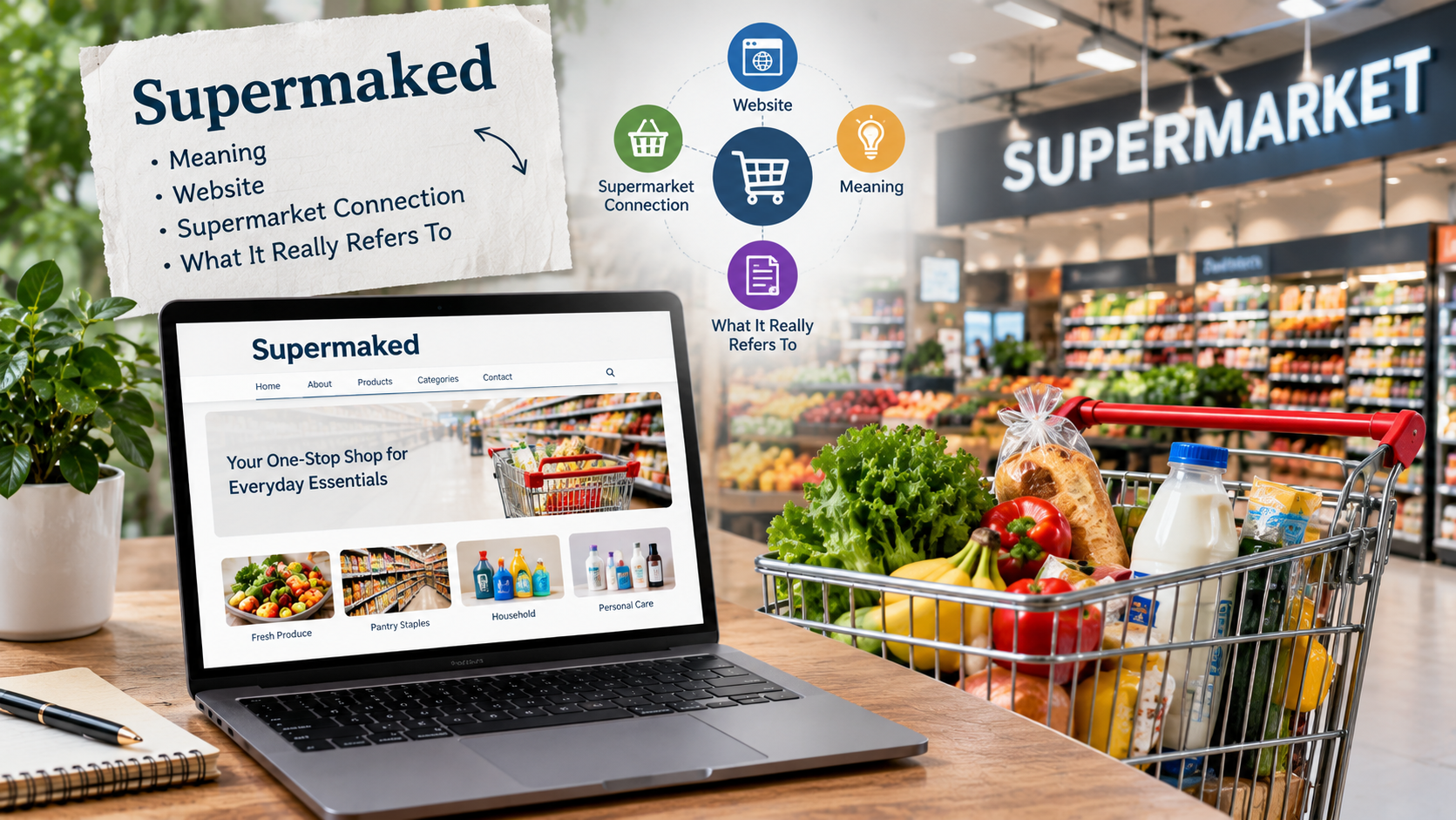
The website using the name describes Supermaked as a variation associated with local markets and supermarket-style shopping. Its homepage discusses groceries, fresh produce, household essentials, convenience foods, customer service, and local communities.
That does not mean every appearance of the word refers to the website. Context matters.
Supermaked vs. Supermarket
The easiest way to understand the difference is to compare the two terms.
| Term | Meaning or use | Status |
| Supermarket | A large retail store selling food and household goods | Established English word |
| Supermaked | An unusual spelling, online name, or brand-style term associated with supermarket-related ideas | No single standard definition |
| Supermaked.com | An active website using “Supermaked” as its name | Specific online identity |
Cambridge provides an established definition for supermarket, including its use for large stores that sell food and household products.
By contrast, Supermaked.com explicitly acknowledges that “Supermaked” is not a standard English word and presents it as a variation associated with supermarkets and local grocery markets.
So, Supermaked should not automatically be treated as another official word for supermarket.
Is Supermaked Just a Misspelling of Supermarket?
Sometimes it could be.
Consider a sentence such as:
“I need to go to the supermaked before dinner.”
In ordinary English, the writer may simply have made a typing mistake and intended supermarket.
The two spellings are extremely close, so accidental substitutions are possible.
But there is another side to the question. Supermaked.com deliberately uses the spelling “Supermaked.” That means it would be inaccurate to say that every occurrence of the term is simply an error. The name exists as an intentional online identity.
The best interpretation is therefore:
- In ordinary writing, supermaked may be a typo for supermarket.
- On a specific website, Supermaked may be a deliberate name.
- In online articles, it may be discussed as a retail-related concept or branding term.
- There is currently no basis for treating it as a universally recognized retail category.
What Is Supermaked.com?
Supermaked.com is an active website that uses “Supermaked” as its name.
Its current navigation includes sections for Blog, Business, Lifestyle, Tech, Health, and Contact us. The homepage presents Supermaked as a name connected with modern local-market and grocery shopping ideas.
The website describes a Supermaked store as a place where shoppers might find:
- Groceries
- Fresh fruits and vegetables
- Dairy products
- Packaged foods
- Beverages
- Household essentials
- Convenience foods
- Ready-to-eat meals
It also discusses organized aisles, customer service, local products, promotions, and community involvement.
These descriptions tell us how the website itself presents the Supermaked idea. They should not automatically be interpreted as independent evidence that a large international supermarket chain exists under that name.
Is Supermaked a Supermarket Chain?
There is not enough reliable evidence to describe Supermaked as an established international supermarket chain.
This distinction matters because a website name and a physical retail network are two different things.
To establish that a company operates a major supermarket chain, you would normally expect verifiable information such as:
- Named physical locations
- A store locator
- Corporate ownership information
- Company registration details
- A documented headquarters
- Clearly identified management
- Independent reporting about its stores
- Customer-facing purchasing infrastructure
The existence of Supermaked.com by itself does not establish all of those things.
The site’s homepage discusses Supermaked stores in general terms, but those descriptions should be treated as the website’s own presentation unless independently verified.
What Does a Supermaked Store Supposedly Offer?
According to Supermaked.com’s own description, the concept is similar to a local grocery or supermarket.
The website says shoppers can expect products such as fresh produce, dairy items, packaged foods, beverages, household essentials, snacks, and ready-to-eat meals. It also describes an emphasis on organization and customer service.
These are not unusual supermarket features.
In fact, they overlap with what shoppers already expect from many supermarkets and grocery stores.
That is why the name and branding are more distinctive than the underlying shopping functions.
Fresh Food
Fresh fruits and vegetables are presented as part of the Supermaked shopping experience.
For a grocery retailer, fresh food can be important because customers often want to complete most of their weekly shopping in one place.
Household Essentials
The website also describes household products as part of the store’s offering.
This reflects the normal supermarket model, where shoppers combine food purchases with everyday household needs.
Convenience Foods
Ready-to-eat meals and convenience products are another part of the description on Supermaked.com.
This type of product is increasingly common across grocery retail because shoppers often want quick meal options alongside ingredients for cooking.
How Is Supermaked Different From a Traditional Supermarket?
The claimed difference is mainly branding and positioning, rather than a completely different retail model.
Supermaked.com’s own comparison describes Supermaked as a more local or branded version of a supermarket, with an emphasis on community and personal service.
However, these characteristics are not unique to the Supermaked name.
Many independent grocery stores already offer:
- Local products
- Personal customer service
- Smaller store layouts
- Community involvement
- Convenience-oriented shopping
- Fresh produce
- Household goods
Therefore, it would be misleading to claim that these features create a completely new type of retail store.
Why Is the Term Supermaked Confusing?
The confusion comes from the one-letter difference between the two words.
Supermarket is familiar.
Supermaked looks familiar but is unusual.
That creates several possible search intentions.
A person searching the keyword may want to know:
- What does supermaked mean?
- Is supermaked a spelling mistake?
- Is Supermaked a company?
- Is Supermaked a supermarket?
- What is Supermaked.com?
- Is there a Supermaked store near me?
- Is Supermaked an online grocery service?
- Does Supermaked have an app or delivery service?
These are different questions, even though they use the same keyword.
A useful article therefore needs to distinguish between the word, the website, and any claims about an actual retail operation.
Is Supermaked an App or Online Grocery Platform?
There is not enough evidence to automatically describe Supermaked as a dedicated grocery-shopping app or major online grocery platform.
Modern grocery retailers commonly use technology such as:
- Mobile apps
- Online ordering
- Home delivery
- Click-and-collect
- Digital loyalty programs
- Electronic payment systems
- Digital coupons
But the existence of these technologies in the wider grocery industry does not prove that Supermaked itself operates all of them.
Supermaked.com’s current homepage discusses modern convenience and mentions possibilities such as online ordering, click-and-collect, and mobile apps when discussing the future of the concept.
That wording should not be interpreted as proof of a specific, verified Supermaked app or delivery network.
Does Supermaked Have Physical Stores?
This is one of the most important questions to treat carefully.
The website discusses “Supermaked stores” and describes how such stores might operate. However, the publicly available homepage does not provide enough information to independently establish a large network of identifiable physical locations.
Therefore, readers should avoid assuming that there is a major Supermaked chain with branches in multiple countries simply because the name appears online.
If someone is looking for a specific physical store, they should verify the store’s address, phone number, business registration, and other local information before making a trip.
What Does Supermaked Mean in Modern Retail?
When used as a broader retail concept, Supermaked is associated online with several familiar trends in grocery shopping.
Convenience
Consumers often want to complete routine shopping quickly.
A modern grocery store can improve convenience through clear layouts, shorter checkout times, online ordering, or convenient locations.
Local Shopping
Smaller grocery stores can serve nearby communities by providing everyday essentials without requiring customers to travel to a large shopping center.
Technology
Retail technology can support inventory management, payment, ordering, customer accounts, and delivery.
But technology is a feature of modern grocery retail generally, not something that automatically belongs to the Supermaked name.
Community Focus
Supermaked.com’s presentation places emphasis on local communities and local suppliers.
This is a common positioning strategy among independent grocery businesses.
Potential Benefits of the Supermarket-Style Model
If “Supermaked” is being used to describe a supermarket-style local shopping experience, several practical benefits make sense.
One-Stop Shopping
A grocery store that combines food, beverages, household products, and convenience items allows shoppers to complete several tasks during one visit.
Time Savings
An organized store can make routine shopping faster because customers spend less time searching for basic items.
Local Access
Neighborhood grocery stores can be particularly useful for people who do not want to travel long distances for everyday purchases.
Local Products
A community-oriented store may carry products from nearby producers or regional suppliers.
However, these are general benefits of grocery retail, not scientifically established benefits unique to Supermaked.
Limitations and Things to Consider
The Supermaked concept also has potential limitations.
Limited Verification
The biggest issue is the lack of clear evidence establishing Supermaked as a major standardized retail category.
Confusing Branding
Because the name resembles “supermarket,” users may assume something about the business that has not been verified.
Different Meanings
A person may use the word as a typo, while another may be referring to Supermaked.com.
Claims May Come From Secondary Sources
Online articles can repeat one another. When several websites make the same statement, that does not necessarily mean the statement has been independently verified.
This is especially relevant for claims about store locations, ownership, apps, delivery services, or technology.
How to Determine What “Supermaked” Means
If you encounter the term online, use a simple process.
Step 1: Check the Context
Look at the sentence where the word appears.
If someone says “I went to the supermaked,” it may simply be a spelling error.
If the word appears as a capitalized name or website title, it may be a brand-style use.
Step 2: Check the URL
If you see Supermaked.com, you are dealing with a specific website rather than merely a typo.
Step 3: Look for Primary Evidence
If an article claims that Supermaked operates stores, check whether it provides:
- Addresses
- Contact information
- Company details
- Official store pages
- Verified business records
Step 4: Separate Claims From Facts
A website saying that a company offers a particular service is not the same as independent evidence proving that service exists.
Step 5: Verify Before Acting
If you intend to visit a store, place an order, or provide personal or payment information, verify that the specific business and service are legitimate first.
Common Mistakes About Supermaked
Mistake 1: Treating It as the Standard Spelling
The standard English word is supermarket, not supermaked. Cambridge defines supermarket as a large store selling food and other household goods.
Mistake 2: Assuming Every Use Is a Typo
That is also too simplistic.
Supermaked.com deliberately uses the spelling as its website name.
Mistake 3: Assuming It Is a Major Global Chain
The existence of a website does not prove the existence of a large international supermarket network.
Mistake 4: Assuming It Is an App
A modern retail discussion may mention apps and digital services without proving that a specific Supermaked app exists.
Mistake 5: Treating Repeated Online Claims as Independent Confirmation
Several websites repeating the same description may simply be drawing from similar sources or from one another.
Independent verification is more valuable than repetition.
Real-World Examples
Example 1: A Typing Error
Someone writes:
“I will buy milk from the supermaked.”
The most likely interpretation is that they meant supermarket.
Example 2: A Website Search
Someone searches Google for “Supermaked” and finds Supermaked.com.
In that case, the spelling is intentional because it is the name used by the website.
Example 3: A Retail Article
An article describes Supermaked as a modern grocery concept.
The reader should ask whether the article is describing a verified company or simply using the word as a conceptual label.
Example 4: Looking for a Store
Someone searches “Supermaked near me.”
The searcher should not assume that every result using the word represents the same business. The actual business name, address, reviews, contact details, and other local information should be checked.
Is Supermaked Safe?
There is no general safety issue associated with the word itself. It is simply a term.
The relevant question is whether a specific website, store, seller, or service using the name is trustworthy.
For any unfamiliar online retailer, sensible precautions include:
- Check the exact domain.
- Look for a physical business address.
- Review contact information.
- Check independent customer feedback.
- Read refund and privacy policies.
- Avoid sending sensitive information unnecessarily.
- Use secure payment methods when making a purchase.
These are normal online-shopping precautions and are not evidence that Supermaked itself is unsafe.
Is Supermaked Legal?
There is nothing inherently illegal about using an unusual spelling such as “Supermaked.”
Whether a particular business operating under that name is legally registered, properly licensed, or authorized to sell particular products is a separate question that depends on the jurisdiction and the specific business.
The term itself does not establish legal status.
Key Facts About Supermaked
- Supermaked is not the standard English spelling of supermarket.
- Supermarket is the established term for a large store selling food and household goods.
- Supermaked is used intentionally as the name of an active website.
- Supermaked.com describes the name in connection with local grocery markets and supermarket-style shopping.
- The website includes sections covering business, lifestyle, technology, health, and other content.
- The term can also appear online as a spelling variation or typo for “supermarket.”
- There is not enough reliable evidence to treat Supermaked as a universally recognized retail category.
- The existence of Supermaked.com does not by itself prove a large physical supermarket chain.
- Claims about apps, delivery networks, or advanced retail technology should be verified separately.
- Context is essential when determining what “Supermaked” means.
Frequently Asked Questions
What does Supermaked mean?
Supermaked is an unusual term associated with supermarkets and grocery retail. It is not the standard English word “supermarket,” and its meaning depends on context. It can appear as an intentional name, particularly through Supermaked.com, or as a spelling variation of supermarket.
Is Supermaked a real word?
It is used online, but it does not have the established standard-English status of “supermarket.” Cambridge provides a formal dictionary definition for supermarket, while Supermaked is used online in more varied ways.
Is Supermaked the same as supermarket?
Not exactly. Supermarket is the established English term for a large food and household-goods store. Supermaked is an unusual spelling and online name that may be related to supermarket concepts.
Is Supermaked a spelling mistake?
It can be when someone intended to write “supermarket.” However, Supermaked is also deliberately used as the name of Supermaked.com, so not every appearance is necessarily a mistake.
Is Supermaked a supermarket company?
The available evidence does not establish Supermaked as a major international supermarket company or chain. The active website uses the name and describes supermarket-style shopping, but those facts alone do not prove a large retail network.
What is Supermaked.com?
Supermaked.com is an active website using “Supermaked” as its name. Its homepage discusses grocery shopping, local markets, convenience, community-oriented retail, and related topics.
Does Supermaked have physical stores?
The website discusses Supermaked stores, but publicly available information does not establish a large, independently verified chain of physical locations. Anyone looking for a specific store should verify its local details separately.
Is Supermaked an app?
There is insufficient evidence to treat Supermaked as a dedicated, established grocery app. General references to mobile apps or digital shopping should not automatically be interpreted as proof of a specific Supermaked application.
Why are people searching for Supermaked?
The unusual spelling resembles “supermarket,” which naturally creates curiosity. Search interest can also come from the active Supermaked.com website and the growing number of online articles discussing the term.
What is the correct spelling: Supermaked or supermarket?
If you mean the standard English word for a large grocery and household-goods store, supermarket is correct.
“Supermaked” may be correct only when referring to a specific name, website, or intentional usage.
Is Supermaked safe to use?
The word itself is neither safe nor unsafe. If you are dealing with a particular website or retailer using the name, evaluate that specific service using normal online-shopping safety checks.
Is Supermaked a new type of supermarket?
There is no authoritative evidence establishing “Supermaked” as a formally recognized new category of supermarket. Some online descriptions use it as a modern retail concept, but that usage should be distinguished from established industry terminology.
Key Takeaways
- Supermaked is an ambiguous online term.
- The established English word is supermarket.
- Supermaked can be a spelling mistake when someone intends to write supermarket.
- Supermaked.com deliberately uses the unusual spelling as its website name.
- The website associates the name with grocery stores, local markets, convenience, and community-oriented shopping.
- There is no strong evidence that Supermaked is a globally established supermarket chain.
- General claims about apps, delivery, physical stores, or retail technology should be verified individually.
- The existence of repeated articles online does not automatically make their claims independently verified.
- If you encounter Supermaked in a sentence, determine its meaning from context.
- If you mean the ordinary English grocery-store term, supermarket is the correct word.
Conclusion
Supermaked is best understood as an unusual and context-dependent term connected with supermarkets and grocery retail. It resembles the established word “supermarket,” but it does not have the same clear dictionary definition.
In ordinary writing, “supermaked” may simply be a typing or spelling error. At the same time, Supermaked is deliberately used as the name of an active website that presents the term in connection with local markets, groceries, convenience, and community-focused shopping.
The distinction matters because an online name should not automatically be treated as proof of a large supermarket chain, app, delivery company, or new retail category.


Masgonzola: What It Is, Ingredients, Taste, Uses, and How It Differs From Gorgonzola

Neworldsmagazine: What It Is, Topics, Website, Content, and What Readers Should Know

Nidia del Carmen Ripoll Torrado: Biography, Family, Shakira Connection, and Life

Kane Brown: The Life and Career of Country Music’s Genre-Blending Star

Lionel Messi: Career, Records, and Where He Stands in 2026

Jason Beck: Detroit Tigers Beat Reporter and One of Baseball’s Most Trusted Voices
-
 Business3 months ago
Kane Brown: The Life and Career of Country Music’s Genre-Blending Star
-
 Sports3 months ago
Lionel Messi: Career, Records, and Where He Stands in 2026
-
 Lifestyle4 months ago
Jason Beck: Detroit Tigers Beat Reporter and One of Baseball’s Most Trusted Voices
-

 Sports3 months ago
Gordon Ramsay’s Brother: Everything Known About Ronnie Ramsay
-

 News3 months ago
NCIS: What the Show Is About, How It Works, and Why It’s Still On the Air
-

 News3 months ago
Amber Heard: Career, Legal History, and Where She Is Today
-

 News3 months ago
Trump Tariffs Explained: What They Are, How They Work, and What They Mean for Prices in 2026
-

 News3 months ago
Patrick Muldoon: The Life and Career of the Days of Our Lives and Starship Troopers Actor